Rowing Glossary: Every Rowing Term Explained
Rowing has its own language. Walk into a boathouse for the first time and you'll hear words like "weigh enough," "crab," "erg," and "catching a crab" — none of which mean what you'd expect.
This glossary covers every term you're likely to encounter, organized by category. Bookmark it and refer back whenever you hit a term you don't recognize.
The Boat
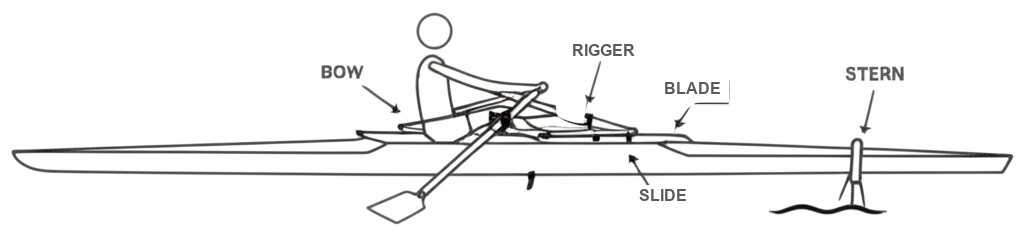
Shell: The boat itself. Racing shells are long, narrow, and made of carbon fiber. The term "shell" refers to the thin, lightweight hull.
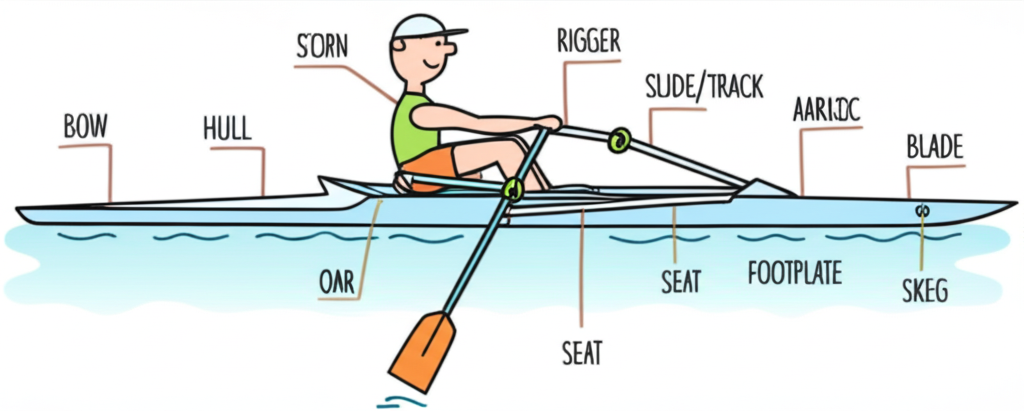
Bow: The front end of the boat — the end that crosses the finish line first. The bow is pointed and often has a small rubber ball on the tip for safety.
Stern: The back end of the boat — where the coxswain sits (in stern-coxed boats) and the end that passes the starting line last.
Port: The left side of the boat when facing the bow (the coxswain's right when seated in the stern). In sweep rowing, port-side rowers have their oar on the left.
Starboard: The right side of the boat when facing the bow (the coxswain's left). Starboard rowers have their oar on the right.
Hull: The body of the boat that sits in the water. Made of carbon fiber in racing shells.
Deck: The flat areas at the bow and stern of the shell that cover the internal structure.
Gunwale (pronounced "gunnel"): The top edge of the hull running along both sides of the boat.
Keel: The centerline of the hull bottom. Some boats have a small external fin (skeg) for tracking stability.
Skeg (or Fin): A small fin on the bottom of the hull near the stern that helps the boat track straight. It's fragile — hitting shallow water or submerged objects will snap it off.
Rigger (or Outrigger): The metal frame that extends from the hull to hold the oarlock. Riggers transfer the force of the oar stroke into the hull. They're made of aluminum or carbon fiber and bolt to the gunwale.
Oarlock (or Rowlock): The U-shaped swivel mechanism at the end of the rigger that holds the oar in place. The oar rotates (pivots) in the oarlock during the stroke.
Gate: The locking bar across the top of the oarlock that keeps the oar from popping out. Always check that gates are closed and tightened before rowing.
Slide (or Track): The pair of metal rails on which the seat rolls. The slide allows the rower to use their legs in the stroke.
Seat: The small wheeled seat that rolls on the slide. Racing seats have two or four wheels and are intentionally minimal.
Footplate (or Foot Stretcher): The platform where rowers place their feet, equipped with shoes or straps. The angle and position are adjustable.
Rudder: A small movable fin under the hull used for steering. In coxed boats, the coxswain controls it directly. In coxless boats, one rower steers via a cable connected to their foot.
Cox Box: An electronic amplification device used by the coxswain. It includes a microphone, speakers that broadcast throughout the boat, a stroke rate display, and a timer. Most clubs provide cox boxes.
Bow Ball: A soft rubber ball fitted to the very tip of the bow. Required by safety regulations to reduce injury risk in collisions.
Slings (or Boat Slings): Portable stands used to hold a boat at waist height for rigging, cleaning, or inspection. Also called "trestles" or "horses."
The Oar
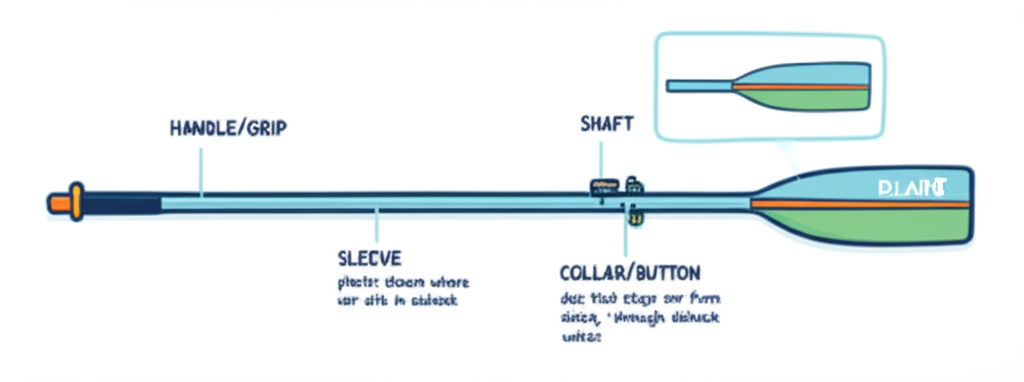
Oar: The lever used to propel the boat. An oar has a shaft, handle (grip), sleeve, collar (button), and blade.
Blade: The flat, wide end of the oar that goes in the water. Modern blades are "hatchet" or "cleaver" shaped (wide and asymmetric). Older blades were "macon" shaped (symmetric tulip shape).
Shaft: The long tube connecting the handle to the blade. Made of carbon fiber in racing oars.
Handle (or Grip): The end of the oar that the rower holds. Covered in rubber or foam for grip.
Sleeve: A plastic tube around the shaft at the point where it sits in the oarlock. Protects the shaft from wear.
Collar (or Button): A plastic disc on the shaft that sits against the oarlock, preventing the oar from sliding through. The collar position determines the inboard length of the oar, affecting leverage.
Scull: A shorter, lighter oar used in sculling. Each sculler holds two sculls, one in each hand. Sculling oars are roughly 9.5 feet long, compared to ~12.5 feet for sweep oars.
Sweep Oar: A longer, heavier oar used in sweep rowing. Each rower holds one sweep oar with both hands.
Inboard: The distance from the collar (button) to the end of the handle. A longer inboard means a shorter outboard and less leverage per stroke.
Outboard: The distance from the collar (button) to the tip of the blade. Longer outboard = more leverage but requires more force.
Span (or Spread): The distance between the two oarlocks, measured across the boat. Affects the leverage ratio and stroke arc.
Technique Terms
Catch: The moment the blade enters the water at the beginning of the drive. A clean catch means the blade enters quickly and fully so the rower can begin driving immediately.
Drive: The power phase of the stroke where the rower pushes with the legs, swings the body, and pulls with the arms. The drive propels the boat forward.
Finish (or Release): The end of the drive, when the blade exits the water. A clean finish means the blade comes out crisply without dragging or splashing.
Recovery: The phase between the finish and the next catch. The rower returns to the starting position: arms extend, body rocks forward, then legs compress. The recovery is the rest phase and should be slower than the drive.
Feathering: Rotating the oar blade from vertical (squared) to horizontal (flat) during the recovery. Feathering reduces wind resistance and clears the blade above the water surface. On the erg, there's no feathering — the handle doesn't rotate.
Squaring: Rotating the blade from horizontal (feathered) to vertical (squared) in preparation for the catch. The blade must be squared before it enters the water.
Rating (or Stroke Rate): The number of strokes per minute (spm). Race rates are typically 30-38 spm for sweep boats and 28-36 for sculling. Training rates are lower (18-24 spm).
Split: The time it takes to cover 500 meters at the current pace. A 2:00 split means 500 meters every 2 minutes. Lower splits = faster speed. The universal pace metric in rowing.
Ratio: The timing relationship between the drive and recovery. A good ratio has a recovery roughly twice as long as the drive (1:2 ratio). Rushing the recovery (1:1 ratio) is a common flaw.
Run: The distance the boat travels between strokes. Longer run = more efficient rowing. You can see run by watching the puddles left by the blades — wider spacing between puddles means more run.
Check (or Checking the Boat): Any action that slows the boat between strokes. Rushing the slide into the catch, slamming into the footplate, or rowing out of sync all cause check. Minimizing check is a primary goal of good technique.
Layback: How far the body leans back past vertical at the finish. Excessive layback wastes energy and delays the recovery. Target: about 11 o'clock (just past vertical).
Body Angle (or Body Prep): The forward lean of the torso at the catch, achieved by hinging at the hips. Typically about 1 o'clock. This forward angle should be established early in the recovery (before the knees bend).
Overcompression: Going too far forward at the catch so that the shins pass vertical. This puts the legs in a mechanically weak position and reduces drive effectiveness.
Washing Out: When the blade exits the water too early during the drive, losing power. The blade "washes out" to the surface before the stroke is complete.
Skying: Raising the blade too high above the water during the recovery, disrupting balance and delaying the catch.
Crab: When the blade gets caught in the water at the finish and the oar handle swings uncontrollably. A "catching a crab" can range from a minor disruption to an ejection (being catapulted out of the boat by the oar handle). It's the most dramatic mistake in rowing.
People
Coxswain (Cox): The crew member who steers the boat, calls commands, and manages race strategy. Does not row. Sits in the stern (most eights) or bow (some fours and pairs). See our complete guide to coxswaining.
Stroke (or Stroke Seat): The rower closest to the stern (and the coxswain). Sets the rhythm for the entire crew. Everyone else follows the stroke seat's timing.
Bow Seat (or Bow): The rower closest to the bow. Often the most technically skilled — their blade work influences boat balance more than any other seat. In coxless boats, the bow seat may have a small mirror to see forward.
Engine Room: The middle seats of the boat (seats 3-6 in an eight), typically occupied by the biggest, most powerful rowers. Their job is to generate maximum watts.
Port Rower: A sweep rower whose oar is on the port (left) side of the boat.
Starboard Rower: A sweep rower whose oar is on the starboard (right) side.
Sculler: A rower who rows with two oars (one in each hand).
Sweep Rower: A rower who rows with one oar held in both hands.
Masters Rower: An adult rower (21+) competing in masters (age-graded) categories. Masters rowing has age brackets in 10-year increments.
Novice: A rower in their first year of competitive rowing, regardless of age. Many regattas have novice categories.
Racing Terms
Regatta: A rowing competition. Can be a sprint regatta (side-by-side racing over 2,000m) or a head race (time-trial format over a longer course). See your first rowing regatta.
Head Race: A longer race (3-6 km) in time-trial format. Boats start at intervals and are ranked by finishing time. Popular in the fall season.
Sprint Race: A shorter race (1,000-2,000m) with boats racing side-by-side in lanes. The standard competitive format and the Olympic distance (2,000m).
Heat: A preliminary race that determines which crews advance to the final (or semifinal). Used when there are more entries than lanes.
Repechage (Rep): A second-chance race for crews that didn't qualify directly from the heats. Reps give additional chances to advance to the final.
Final: The championship race that determines placings and medals.
Lane: A designated water lane for sprint racing, defined by buoys. Standard courses have 6-8 lanes.
Stake Boat: A floating platform at the start of a sprint course where a person holds the stern of each boat to keep it aligned. Not all courses have stake boats — some use self-alignment.
False Start: Starting before the official command. Depending on the rules, a false start may result in a warning, restart, or disqualification.
Weigh Enough: The command to stop rowing. Equivalent to "halt" or "stop." One of the most iconic rowing commands.
Hold Water: An emergency stop command. Rowers place their blades flat in the water to brake the boat.
Power 10 (or Power 20): A call from the coxswain for a set number of strokes at maximum effort. Used to make a move on another crew or close a gap.
Settle: The call to lower the stroke rate from the high start rate down to race pace.
Sprint: The final push at the end of a race, usually the last 200-500 meters. Rate goes up, effort goes to maximum.
Margin: The distance between boats at the finish. Measured in seconds (time margin) or lengths of a boat. An "open water" margin means one boat had clear water between it and the next — a decisive win.
DNS: Did Not Start. A crew that was entered but didn't race.
DNF: Did Not Finish. A crew that started but didn't complete the race.
DQ: Disqualified. Removed from results for a rule violation.
Training Terms
Erg (Ergometer): An indoor rowing machine. Almost always refers to a Concept2 rower. "Erging" = rowing on an ergometer. See our rowing machine buyer's guide.
Steady State (SS): Low-intensity, long-duration rowing at a conversational pace and low stroke rate (18-22 spm). The foundation of rowing training — roughly 80% of total training volume should be steady state.
UT2 (Utilization 2): The lowest training intensity zone — easy, aerobic, conversational. Heart rate roughly 60-70% of max. This is what most people mean by "steady state."
UT1 (Utilization 1): A slightly harder aerobic zone — still sustainable but not quite conversational. Heart rate roughly 70-80% of max.
AT (Anaerobic Threshold): The intensity at which lactate production equals lactate clearance. Training at AT (also called "threshold training" or "tempo") builds the ability to sustain high effort. Heart rate roughly 80-90% of max.
VO2 Max: Maximum oxygen consumption — the ceiling of your aerobic system. Interval training at near-max effort trains VO2 max. Heart rate 90-100% of max.
2K Test: The standard performance test in rowing — a 2,000-meter all-out effort on the erg. The most important benchmark in the sport.
Split: See Technique Terms above. In training context, "what's your split?" means "what's your 500m pace?"
Watts: A measure of power output on the erg. Unlike split (which has a cubic relationship to power), watts are linear — doubling your watts requires doubling your power. The Concept2 PM5 displays both.
Drag Factor: A number on the Concept2 that represents the actual resistance the flywheel experiences, accounting for damper setting and environmental conditions. Most rowers train at a drag factor of 110-140.
Damper: The lever on the side of a Concept2 erg (1-10) that controls airflow to the flywheel. It is not a difficulty setting. Lower settings (3-5) feel lighter and are used by most competitive rowers. See Concept2's explanation.
Piece: A single rowing effort — either a timed segment or a fixed distance. "Do a 20-minute piece" means row for 20 minutes continuously.
Interval: A structured workout alternating work and rest. Example: 8 x 500m with 2 minutes rest.
Seat Racing: A method of evaluating rowers by swapping individuals between otherwise identical boats and comparing times. The rower whose boat goes faster in direct comparison earns the seat. Used for crew selection.
Boathouse Terms
Boathouse: The building where boats are stored, usually on racks. Also the social hub of a rowing club.
Bay: A storage area within the boathouse, usually organized by boat size.
Rack: Horizontal bars or cradles where boats are stored, stacked vertically. Boats are stored upside down (hull up) to protect the riggers and prevent water accumulation.
Slings: See The Boat section above.
Launch: (noun) A motorboat used by coaches to follow crews on the water and provide instruction. (verb) To put a boat in the water.
Dock: The platform at the water's edge where boats are launched and docked. Docking is a skill — approaching too fast or at the wrong angle can damage the boat.
Rigging: The process of adjusting the mechanical setup of the boat — oarlock height, span, pitch, footplate angle, etc. — to optimize performance for specific rowers. Also refers to the physical rigger hardware.
Boat Types (Quick Reference)
| Abbreviation | Name | Rowers | Type |
|---|---|---|---|
| 1x | Single | 1 | Scull |
| 2x | Double | 2 | Scull |
| 2- | Pair | 2 | Sweep (no cox) |
| 2+ | Coxed Pair | 2+cox | Sweep |
| 4x | Quad | 4 | Scull |
| 4- | Four | 4 | Sweep (no cox) |
| 4+ | Coxed Four | 4+cox | Sweep |
| 8+ | Eight | 8+cox | Sweep |
For full descriptions of each boat type, see our rowing boat types explained.
More Resources
- The beginner's guide to rowing technique — put these terms into practice
- How to join a rowing club — where you'll use this vocabulary daily
- Rowing machine buyer's guide — understanding erg terminology
- Rowing media and news — follow rowing coverage with full comprehension
- Browse the full rowing directory — every rowing resource organized by category