
What Does a Coxswain Do? The Complete Guide to Coxing
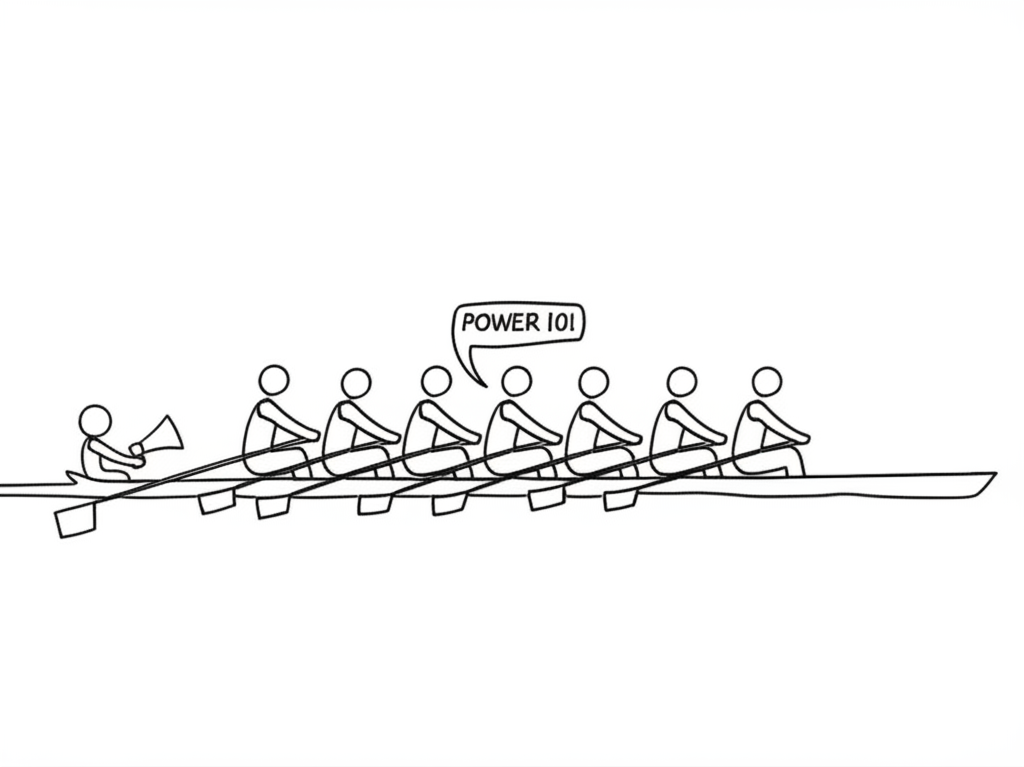
The coxswain is the most misunderstood position in rowing. From the outside, it looks like one person yelling while eight people do the actual work. From the inside, the coxswain is the brain of the boat — responsible for steering, race tactics, crew motivation, safety, and on-water decision-making.
Great coxswains win races. Bad coxswains lose them. Here's how to be a good one.
What Does a Coxswain Do?
The coxswain (pronounced "COX-in," often shortened to "cox") has five core responsibilities:
1. Steer the Boat
The coxswain controls the rudder, either by hand (in bow-coxed boats) or with strings connected to the feet (in stern-coxed boats). Steering sounds simple, but it's critical — a crooked course adds distance and costs time. In a 2,000m race, a boat that weaves even slightly can travel 2,020-2,050m. At elite speeds, those extra meters cost seconds.
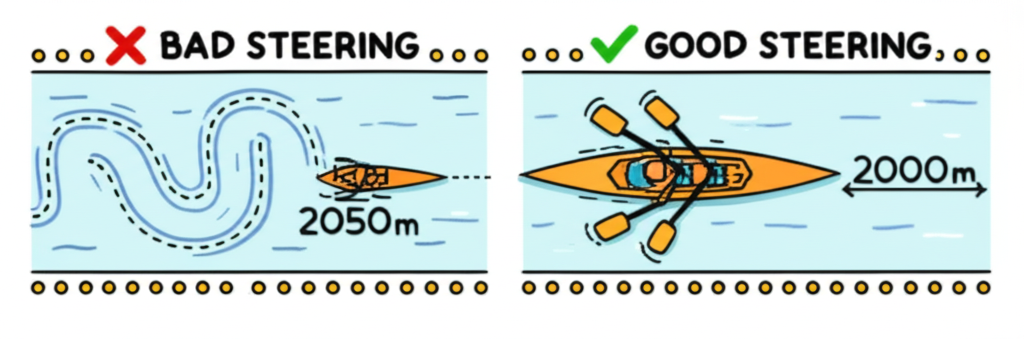
Good steering means:
- Straight lines. Pick a point on the horizon and row toward it.
- Minimal rudder. Every rudder adjustment creates drag. Make small corrections early rather than large corrections late.
- Looking ahead. Anticipate turns (in head races) and current/wind drift. React before the boat veers off course, not after.
2. Execute the Race Plan
The coach sets the strategy. The coxswain executes it on the water. This means knowing:
- When to call a high start and how many strokes
- What rate to settle at and when to call the settle
- Where power moves happen (e.g., "10 strokes for power at the 1000m mark")
- When to sprint and how to manage the final push
The coxswain must adapt the plan in real time. If another crew surges ahead, do you respond or stick to the plan? If conditions change mid-race, do you adjust the rate? These decisions happen in seconds, and the crew depends on the coxswain to make the right call.
3. Provide Technical Feedback
The coxswain is the only person in the boat who can see the entire crew. Rowers face backward and can only feel what's happening. The coxswain provides real-time corrections:
- "Stern pair, you're early at the catch — wait for bow."
- "Three seat, your blade is going in deep. Top edge only."
- "Everyone, slow down the recovery. Ratio is getting rushed."
The best coxswains know what each rower needs to hear and when. During the warm-up, feedback is detailed and technical. During a race, it's short, actionable, and motivating. Nobody wants a technique lecture at 1500m of a 2K.
4. Motivate the Crew
At 1200m of a 2K race, every rower's legs are on fire, their lungs are screaming, and their brain is telling them to stop. The coxswain is the voice that cuts through the pain and keeps the crew fighting.
Effective race calls:
- Position calls: "We're even with Riverside. We move in this next 20." Knowing where you stand is motivating.
- Power calls: "Ten strokes, LEGS. One... two... three..." Focused, counted bursts give the crew something to execute.
- Psychological calls: "This is what we trained for. We're stronger than they are. Push NOW." These hit hardest in the final 500m.
- Rhythm calls: "Together. Together. Together." When the boat starts to fall apart, bringing attention back to crew synchrony can settle things down.
What doesn't work: constant screaming, negative feedback ("you're behind, we're losing"), or vague commands ("row harder"). The crew needs specific, positive, actionable calls.
5. Ensure Safety
The coxswain is responsible for the safety of the crew and the boat. This means:
- Watching for obstacles — other boats, buoys, docks, debris, bridges, wildlife
- Knowing the traffic pattern — which side of the river to row on, where to turn, where to yield
- Assessing conditions — if wind or waves are dangerous, the coxswain can make the call to head in
- Managing emergencies — if someone is injured, if the boat is taking on water, or if a collision occurs, the coxswain takes charge
Every rower in the boat trusts the coxswain with their physical safety. Take that responsibility seriously.
Coxswain Commands
Here are the essential commands every coxswain needs to know.
Dock and Launch Commands
| Command | Meaning |
|---|---|
| "Hands on" | Crew grabs the boat to lift or move it |
| "Up and over heads" | Lift the boat overhead (for carrying) |
| "Down to waists" | Lower the boat to waist height |
| "Roll to port/starboard" | Roll the boat to one side for placing in water or on rack |
| "One foot in, ready... row" | Getting into the boat from the dock, then pushing off |
| "Hold water" | Stop the boat by placing blades flat in the water |
| "Weigh enough" | Stop rowing (the rowing equivalent of "halt") |
Rowing Commands
| Command | Meaning |
|---|---|
| "Sit ready" | Get into the catch position, ready for the first stroke |
| "From the finish, ready... row" | Start rowing from the finish position (most common start) |
| "Arms only" / "Arms and body" / "Half slide" / "Full slide" | Drill progressions building up to the full stroke |
| "Power 10" | Ten strokes at maximum effort |
| "Bump it up 2 (beats)" | Increase stroke rate by 2 strokes per minute |
| "Settle" | Lower the rate and find a sustainable rhythm |
| "Let it run" | Stop rowing and let the boat glide to feel the balance |
| "Check it down" | Emergency stop — square blades in the water to brake |
Race Start Commands
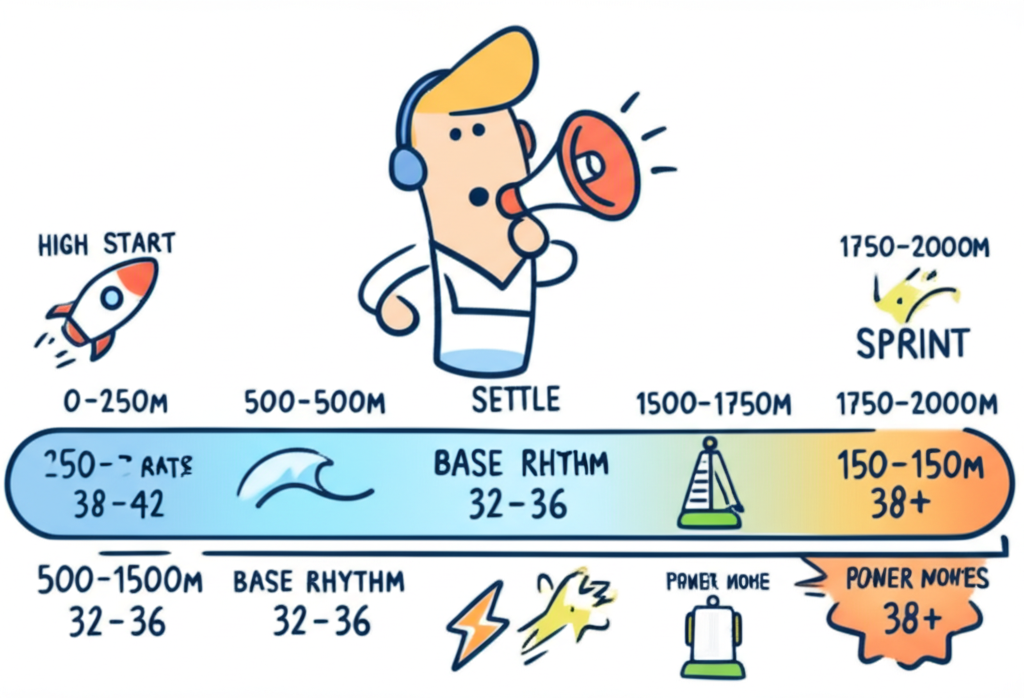
A typical race start sequence:
- "Sit ready at the catch" — crew in the starting position
- "Attention..." — the official's command
- "ROW!" — from the official. Then the cox takes over:
- "GO! Half, half, three-quarter, three-quarter, FULL, LENGTHEN" — the first 6 strokes progressively build from half-slide to full-slide
- "Settle in 2... 1... 2... settle" — transition from high-rate start to race pace
Steering Techniques
Sprint Races (Straight Course)
In a buoyed lane, your job is to keep the boat in the center of the lane. Pick a point at the far end of the course (a flag, building, or tree) and aim at it. Make micro-corrections early. If you wait until the boat is veering visibly, you'll overcorrect and snake down the course.
Pro tip: In a tailwind, the stern swings more. In a headwind, the bow tends to push off course. Adjust accordingly.
Head Races (River Course with Turns)
Head races require real steering skill. You'll navigate bridges, bends, other boats, and sometimes narrow channels. Key principles:
- Take the inside of turns. The shortest distance is on the inside. Cutting corners (while staying in your water) saves significant time over a 5K course.
- Set up early. Start your turn 5-10 strokes before the actual bend. If you wait until you're at the turn, you'll swing wide.
- Use calls, not just rudder. On a sharp turn, you can ask the outside rowers to pull harder ("stern pair, pressure up") or the inside rowers to ease off. This turns the boat faster than rudder alone without adding drag.
- Look ahead. Your vision should be 50-100 meters ahead, not at the point of the bow. Anticipate.
Weight and Size
Weight Requirements
In competitive rowing, coxswains have a minimum weight requirement to prevent a competitive advantage from simply having the lightest possible person in the seat.
- Men's crew: Minimum 55 kg (121 lbs) at weigh-in
- Women's crew: Minimum 50 kg (110 lbs) at weigh-in
If a coxswain is under the minimum, they carry dead weight (sandbags or weight plates placed in the boat). This equalizes the penalty so lighter coxswains aren't penalized or advantaged.
At the recreational and club level, weight minimums are less strictly enforced, but lighter coxswains are generally preferred because every pound affects boat speed.
Size Matters (But Not How You Think)
Coxswains are typically smaller people — which makes sense given the weight considerations. But the position is open to anyone. What matters more than size:
- Voice: Can the crew hear you? A strong, clear voice is more important than a loud one. Most racing boats have a cox box (amplification system) that broadcasts your voice through speakers in the boat.
- Confidence: The crew needs to trust that you know what you're doing. Project calm authority.
- Rowing IQ: Understanding technique, race tactics, and the physics of rowing makes your calls intelligent and credible.
How to Become a Good Coxswain
1. Learn the Rowing Stroke
You can't give technical feedback if you don't understand the technique. Spend time on the erg. Row in a boat if possible. Read our beginner's guide to rowing technique. Watch video of elite crews. The better you understand what good rowing looks and feels like, the more useful your feedback will be.
2. Record Yourself
Record your race calls and listen back. You'll be surprised by what you hear — dead air where there should be calls, filler words ("um," "like"), calls that are too long or too vague, or a voice that sounds uncertain. Recording is the fastest path to improvement.
3. Study Race Footage
Watch coxswain recordings from major regattas (many are available on YouTube). Listen to how elite coxswains pace their calls, build intensity through the race, and make tactical decisions. Note the rhythm and cadence of their voice — it often matches the stroke rate.
4. Build Relationships With Your Rowers
Every rower responds to different cues. Some want aggressive motivation. Some want calm technical reminders. Some need encouragement, others need a push. The only way to learn what each person needs is to talk to them off the water and observe what works on it.
5. Debrief After Every Row
After every practice and race, ask your rowers and coach: what worked? What didn't? Was there a call that helped? A moment where you could have said something better? Coxswains who actively seek feedback improve faster than those who don't.
6. Know the Rules
Read the USRowing rules of racing (or your national federation's rules). Know what constitutes a false start, what happens if you encroach on another lane, and what the procedure is for a restart. Officials expect coxswains to know the rules.
Coxswain Gear
- Cox box: An amplification unit that broadcasts your voice through speakers in the boat. Most clubs provide these. Learn how to use it, including rate display, timer, and volume.
- Waterproof clothing: You will get wet. A splash jacket or rain gear is essential, especially in head races.
- Sunglasses: You're facing forward and staring into sun, water reflections, and spray for the entire practice. Polarized lenses are best.
- Small waterproof notepad/pencil: For recording workout splits and coach instructions during practice.
More Resources
- The beginner's guide to rowing technique — understand what you're coaching
- Rowing boat types explained — know every boat your coxswain seat sits in
- Your first rowing regatta — what the racing experience looks like
- How to join a rowing club — many clubs actively recruit coxswains
- Rowing organizations — national and international governing bodies and their rules