Types of Rowing Boats: Singles, Pairs, Fours and Eights
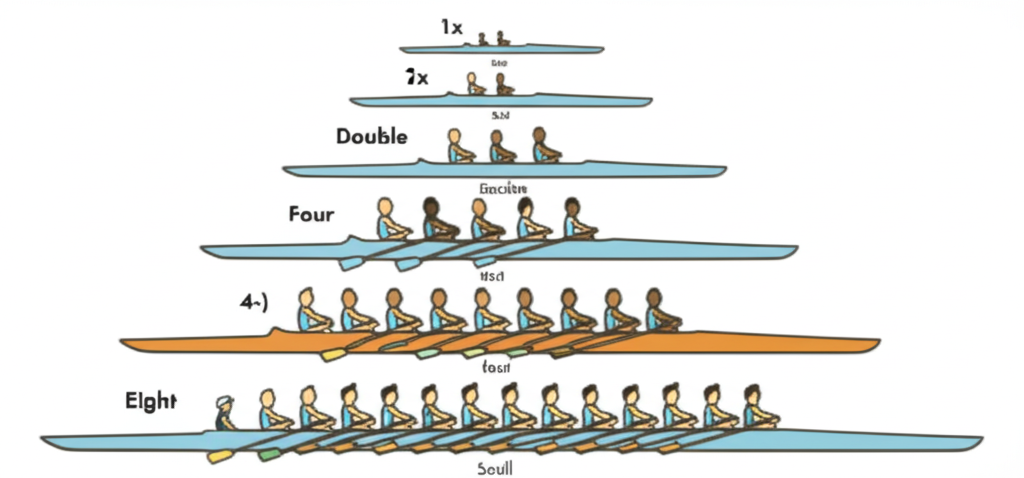
Walk into any boathouse and you'll see boats of wildly different sizes — from sleek 27-foot singles barely wider than your hips to 62-foot eights that need eight people to carry. Each boat type has a different feel, crew size, and role in the sport.
Here's a breakdown of every boat type in rowing, what the abbreviations mean, and what each one is actually like to row.
Sculling vs. Sweep
Before diving into boat types, understand the two fundamental styles of rowing.
Sculling
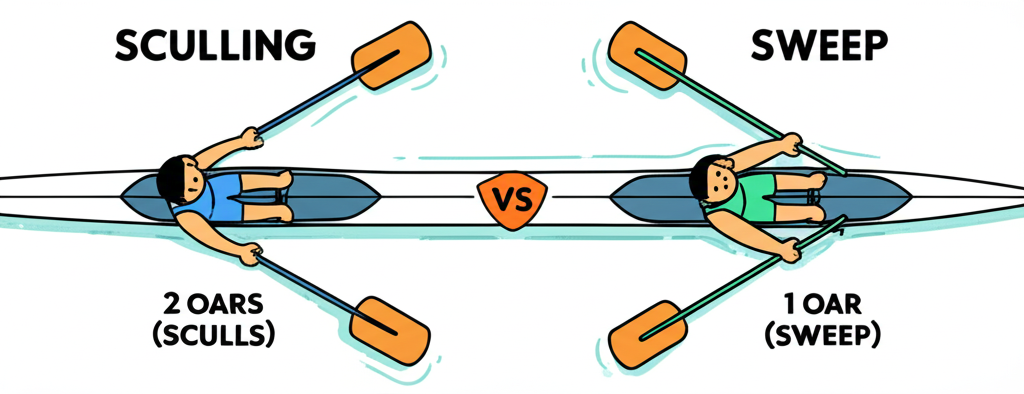
Each rower holds two oars (called sculls), one in each hand. The oars are shorter and lighter than sweep oars. Sculling boats include singles (1x), doubles (2x), and quads (4x).
Sculling is more technically demanding because you're controlling two oars independently while balancing a narrow boat. But it also gives you more control and independence — you can go out alone in a single whenever you want.
Sweep Rowing
Each rower holds one oar with both hands. The oar is longer and heavier than a scull. Sweep boats include pairs (2-), fours (4-), and eights (8+). Sweep crews need to be balanced — the same number of rowers pulling on port (left) and starboard (right) sides.
Sweep rowing is what most people picture when they think of rowing: eight people in a long boat, moving in perfect synchrony, with a coxswain steering and calling commands.
The Naming System
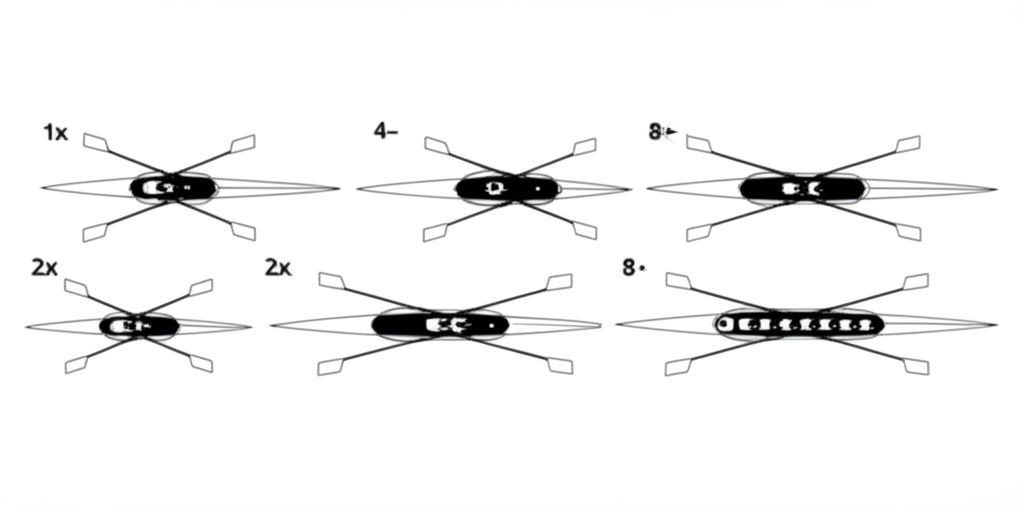
Rowing uses a concise notation for boat types:
- The number = how many rowers
- x = sculling (two oars per person)
- - = sweep boat without a coxswain (coxless)
- + = sweep boat with a coxswain (coxed)
So: 4x = four rowers, each with two sculls. 2- = two rowers, each with one sweep oar, no coxswain. 8+ = eight rowers with one sweep oar each, plus a coxswain.
Sculling Boats
Single (1x)
Rowers: 1 | Length: ~27 ft / 8.2 m | Weight: ~31 lbs / 14 kg
The single is rowing in its purest form. One person, two oars, alone on the water. It's the most technically demanding boat because there's no one else to balance it, steer it, or cover your mistakes.
What it's like: Exhilarating and humbling. A single amplifies everything — good technique feels like flying, bad technique dumps you in the water. The boat responds instantly to every shift in weight and pressure. When it clicks, there's nothing like it in sport.
Who rows it: Experienced scullers, elite athletes training individually, and recreational rowers who want independence. Most clubs don't put beginners in singles until they've developed solid technique in larger boats.
Double (2x)
Rowers: 2 | Length: ~34 ft / 10.4 m | Weight: ~60 lbs / 27 kg
Two scullers, sitting one behind the other. The double is more stable than a single and faster because two people generate more power. It requires coordination between partners but is forgiving enough for intermediate scullers.
What it's like: A great balance of speed, stability, and teamwork. Finding rhythm with your partner is the key challenge. A well-matched double is one of the most enjoyable boats to row.
Who rows it: Recreational scullers, masters rowers, and competitive athletes. The double is one of the Olympic events.
Quad (4x)
Rowers: 4 (sometimes with coxswain: 4x+) | Length: ~44 ft / 13.4 m | Weight: ~114 lbs / 52 kg
Four scullers in a fast, stable boat. Quads are popular in club and masters rowing because they're stable enough for developing scullers but fast enough for serious competition.
What it's like: Stable and powerful. Four people generating power through sculling makes for impressive boat speed. Coordination is critical — four people sculling out of sync creates chaos. Coxed quads (4x+) are common in junior and development programs.
Who rows it: Club rowers, juniors, masters competitors. A great stepping stone between doubles and competitive sculling.
Sweep Boats
Pair (2-)
Rowers: 2 | Length: ~34 ft / 10.4 m | Weight: ~62 lbs / 28 kg
Two sweep rowers, one oar each, no coxswain. The pair is the most technically demanding sweep boat and often considered the hardest boat in rowing to row well. With only one oar each, balance is entirely on the two rowers.
What it's like: Brutally honest. The pair exposes every flaw. If one rower's timing is off by a fraction of a second, the boat wobbles. But a good pair — two rowers perfectly matched in timing and power — moves beautifully. It's the purest test of sweep rowing ability.
Who rows it: Experienced sweep rowers and competitive athletes. The pair is an Olympic event and is often used by coaches to evaluate technique.
Coxed Pair (2+)
Rowers: 2 + coxswain | Length: ~36 ft / 11 m | Weight: ~70 lbs / 32 kg
Same as the pair but with a coxswain for steering and commands. Slightly heavier and slower but easier to manage. Coxed pairs are rare in competitive racing at the elite level but used in some club and development programs.
Four (4-)
Rowers: 4 | Length: ~44 ft / 13.4 m | Weight: ~112 lbs / 51 kg
Four sweep rowers without a coxswain. One of the prestige events in rowing — the coxless four has been an Olympic event since 1904. It demands four rowers who can balance the boat, steer via foot-mounted rudder, and maintain synchrony without a coxswain's guidance.
What it's like: Fast and demanding. With no coxswain, one rower steers using a small rudder connected to their foot. The crew must self-organize, call moves, and stay in rhythm without an outside voice. A well-rowed four is beautiful to watch.
Who rows it: Competitive and experienced crews. The four is a flagship Olympic event.
Coxed Four (4+)
Rowers: 4 + coxswain | Length: ~46 ft / 14 m | Weight: ~120 lbs / 55 kg
Four sweep rowers with a coxswain. More common in club and junior rowing than the coxless four. The coxswain handles steering and race strategy, which makes it more manageable for developing crews.
What it's like: A good training boat for sweep rowing. The coxswain takes care of steering and calls, letting the rowers focus on technique and power.
Eight (8+)
Rowers: 8 + coxswain | Length: ~62 ft / 19 m | Weight: ~210 lbs / 96 kg
The eight is the flagship boat of rowing. Eight sweep rowers and a coxswain, racing at speeds over 14 mph (22 km/h). Eights always have a coxswain — the boat is too long and the crew too large to steer without one.
What it's like: Power, speed, and adrenaline. An eight generates more absolute speed than any other rowing boat. When eight people are in perfect sync, the boat surges forward on every stroke with a feeling unlike anything else in the sport. The eight is also the most stable sweep boat, making it ideal for beginners.
Who rows it: Everyone from beginners to Olympic athletes. The eight is the marquee event at most regattas and the boat most clubs use for Learn to Row programs because of its stability.
Boat Comparison
| Boat | Rowers | Type | Cox | Length | Weight | Stability |
|---|---|---|---|---|---|---|
| 1x | 1 | Scull | No | 27 ft | 31 lbs | Low |
| 2x | 2 | Scull | No | 34 ft | 60 lbs | Medium |
| 2- | 2 | Sweep | No | 34 ft | 62 lbs | Low |
| 2+ | 2+1 | Sweep | Yes | 36 ft | 70 lbs | Medium |
| 4x | 4 | Scull | No | 44 ft | 114 lbs | High |
| 4- | 4 | Sweep | No | 44 ft | 112 lbs | Medium |
| 4+ | 4+1 | Sweep | Yes | 46 ft | 120 lbs | High |
| 8+ | 8+1 | Sweep | Yes | 62 ft | 210 lbs | High |
Boat Positions and Seat Numbers
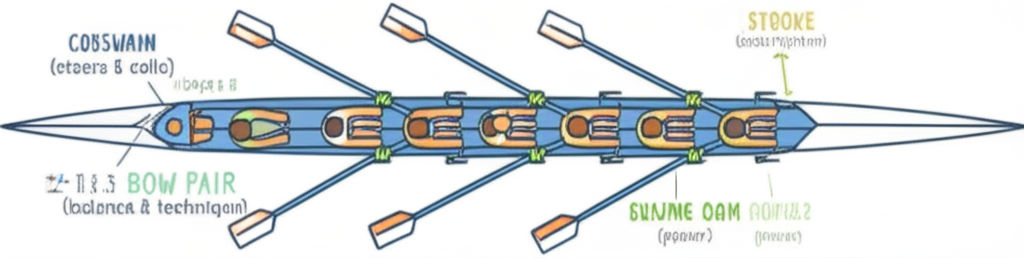
In a rowing boat, seats are numbered from the bow (front) to the stern (back):
- Bow (seat 1): The rower closest to the front. Often the most technically skilled — their blade work sets the tone for the crew and they have the most influence on balance.
- Stern pair (seats 7-8 in an eight, or the "stroke pair"): Sets the rhythm. The stroke seat (closest to the stern) is the rower everyone else follows.
- Engine room (middle seats): Typically the biggest, most powerful rowers. Their job is to generate watts.
- Coxswain (cox): Sits in the stern (or sometimes the bow in smaller boats). Steers, calls commands, manages race strategy, and motivates the crew. Not a rower — the coxswain is a crew member with a completely different skill set.
What Boats Are Made Of
Modern racing shells are built from carbon fiber composite — the same material used in Formula 1 cars and aerospace. Carbon fiber makes boats extremely light and stiff, which maximizes speed. An eight weighing 210 lbs carries 9 people totaling 1,500+ lbs.
The tradeoff is fragility. Racing shells are built for performance, not durability. Hitting a dock, another boat, or a submerged object can puncture or crack the hull. Boats are treated with care — there are strict rules about how to carry, store, and dock them.
Major manufacturers include Empacher (Germany), Vespoli (USA), Filippi (Italy), and Hudson (Canada). Browse our manufacturers directory for the full list.
Olympic Boat Classes
The Olympic rowing program features 14 events — 7 for men and 7 for women:
Sculling events: Single (1x), Double (2x), Quad (4x)
Sweep events: Pair (2-), Four (4-), Eight (8+)
Lightweight: Lightweight double (L2x) — the only weight-class event remaining in Olympic rowing.
All 14 events will be contested at the 2028 Los Angeles Olympics at the Long Beach Marine Stadium.
Which Boat Should You Start In?
If you're a complete beginner, your club will decide for you — and it will almost certainly be a coxed eight (8+) or a coxed four (4+). These are the most stable boats with the most support (a coxswain to steer and guide you).
As you develop, here's a typical progression:
- 8+ or 4+ — Learn the basics in a stable, coached boat
- 4- or 4x — More responsibility, less stability
- 2x or 2- — Partner skills, higher technical demand
- 1x — The ultimate test of independent rowing skill
There's no rush. Many experienced rowers spend their entire careers happily rowing in eights and fours. Others are drawn to the challenge of small boats. Both paths are valid.
More Resources
- Rowing manufacturers — who builds these boats
- The beginner's guide to rowing technique — master the stroke before worrying about the boat
- How to join a rowing club — get on the water
- Your first rowing regatta — what happens when you race these boats
- Rowing equipment directory — oars, riggers, electronics, and more