The Path to the 2028 Olympics: A Rower's Roadmap to LA
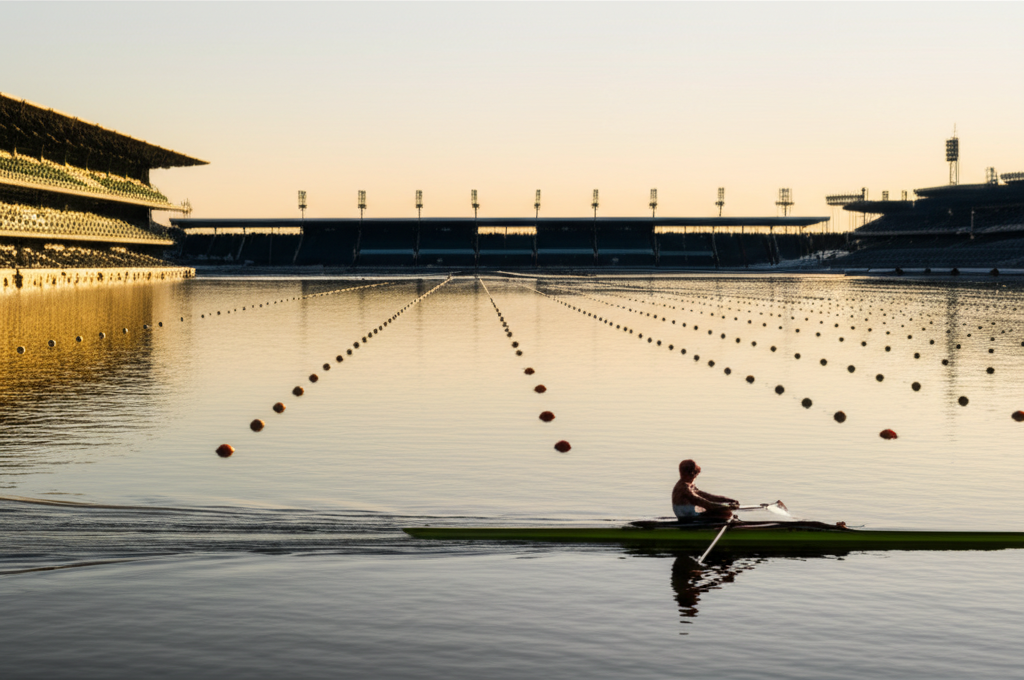
The 2028 Los Angeles Olympics are roughly 28 months away. If you're a competitive rower with Olympic aspirations, the clock is ticking — but the path is clear if you know what to look for. This guide breaks down everything you need to know about getting from where you are now to the starting line at Long Beach Marine Stadium.
What's Different About LA 2028
Before we map out the path, there are some important changes for 2028 that every aspiring Olympian needs to know.
The race distance is 1,500 meters. Due to the dimensions of Long Beach Marine Stadium, Olympic rowing races will be 1,500m instead of the standard 2,000m. This is the shortest distance ever used for Olympic rowing. All qualification events (World Championships, World Cups) will still be raced at 2,000m — only the Games themselves will use the shorter course.
Lightweight events are gone. Paris 2024 was the last Olympics to feature lightweight double sculls. LA 2028 drops both the men's and women's lightweight double.
Beach sprint rowing debuts. Three new beach sprint events (men's 1x, women's 1x, mixed 2x) join the program, bringing the total to 15 medal events.
The Olympic Boat Classes
LA 2028 will feature 12 classic rowing events. Here are the four boat classes we'll focus on, available for both men and women:
| Boat Class | Event Code | Crew Size | Type |
|---|---|---|---|
| Single Sculls | 1x | 1 rower | Sculling |
| Double Sculls | 2x | 2 rowers | Sculling |
| Quadruple Sculls | 4x | 4 rowers | Sculling |
| Eight | 8+ | 8 rowers + cox | Sweep |
The remaining events (coxless pair and coxless four) round out the 12 classic events.
How Countries Qualify Boats
Olympic qualification in rowing is a two-step process: first, your country must qualify a boat in a specific event. Then, you must earn a seat in that boat through your national federation's selection process. Qualifying a boat earns a spot for the country, not for individual athletes.
Phase 1: 2027 World Rowing Championships (Primary Qualification)
The 2027 World Championships in Lucerne, Switzerland will be the primary Olympic qualifying regatta. Approximately two-thirds of all Olympic quota places are awarded here based on finishing position.
Expected qualification spots available at Worlds by event:
| Event | Approximate Spots |
|---|---|
| Single Sculls (1x) | ~9 |
| Double Sculls (2x) | ~11 |
| Quadruple Sculls (4x) | ~7 |
| Eight (8+) | ~5 |
The eight has the fewest qualification spots because there are fewer countries fielding competitive eights — it's the most resource-intensive boat class.
Phase 2: Continental Qualification Regattas (Spring 2028)
Four continental regattas offer additional spots for countries that didn't qualify at Worlds:
- Asia/Oceania Continental Qualification
- African Continental Qualification
- Americas Continental Qualification
- European Continental Qualification
Phase 3: Final Olympic Qualification Regatta (Spring 2028)
A last-chance regatta open to all remaining countries provides the final available spots.
The bottom line: The 2027 World Championships is the event that matters most. If your country qualifies a boat there, the path to the Olympics is much smoother.
The US Selection Process
USRowing uses a structured, multi-phase selection system. Understanding how it works is critical.
The "Small Boats First" Philosophy
USRowing currently prioritizes selecting small boats first (1x, 2x, pairs), then moves to fours and quads, and finally eights. How you're selected depends on your target boat class.
Trials-Selected Boats (1x, 2x, 2-)
Athletes earn seats through head-to-head racing at championship trials. You race, you win, you're in. This is the most straightforward path.
Camp-Selected Boats (4x, 4-, 8+)
Athletes for larger boats are selected through a camp process at USRowing Training Centers. This involves:
- Seat racing (swapping athletes in and out of boats and comparing times)
- Coach evaluation and discretion
- Erg testing results
- Speed Order performance
The Selection Timeline
Here's how a typical selection year unfolds:
- Submit erg scores — Athletes must submit both a 2,000m and 6,000m erg test to USRowing
- Fall Speed Orders (November) — Small boat time trials at Mercer Lake, West Windsor, NJ
- Winter Speed Orders (March) — More time trials in Sarasota, FL
- Selection Camp I (May-June) — Camp-based selection begins in Sarasota
- Submit updated erg scores (before July 1)
- Summer Speed Orders (July) — Final small boat time trials at Mercer Lake
- Selection Camp II (July-August) — Final camp selection at West Windsor
- Championship Trials (August) — Head-to-head racing to determine US crews
- World Championships (August-September) — Race for the US
Winners of Speed Orders in the 1x and 2- earn automatic camp invitations. Remaining athletes are invited at the discretion of the Chief High Performance Officer.
Training Centers
If you're serious about making the team, you'll likely need to train at one of USRowing's two national training centers:
- Princeton Training Center (Caspersen Boathouse), Mercer Lake, West Windsor, NJ — 40-60 national team athletes train here year-round on a 10-lane, 2,000m course
- Sarasota Training Center, Nathan Benderson Park, FL — Used for winter/spring training and selection events
The Timeline: March 2026 to July 2028
2026 Season — Establish Yourself
| When | Event | Where |
|---|---|---|
| March | Winter Speed Orders | Sarasota, FL |
| May 29-31 | World Rowing Cup I | Seville, Spain |
| May-June | Selection Camp I | Sarasota, FL |
| June 12-14 | World Rowing Cup II | Plovdiv, Bulgaria |
| June 26-28 | World Rowing Cup III | Lucerne, Switzerland |
| July 3-5 | Summer Speed Orders | West Windsor, NJ |
| July-Aug | Selection Camp II | West Windsor, NJ |
| Early Aug | Championship Trials | West Windsor, NJ |
| Aug 24-30 | World Championships | Amsterdam, Netherlands |
| November | Fall Speed Orders | West Windsor, NJ |
Your 2026 goal: Get into the national team pipeline. Earn camp invitations. Race at nationals. Get international experience at World Cups. Compete at the 2026 World Championships in Amsterdam.
2027 Season — The Year That Matters Most
| When | Event | Where |
|---|---|---|
| Q1 | Winter training and erg testing | Training centers |
| Spring | Speed Orders and Selection Camps | Sarasota / Princeton |
| May-July | World Rowing Cup Series (3 events) | TBD |
| Aug-Sep | 2027 World Championships | Lucerne, Switzerland |
Your 2027 goal: This is the Olympic qualifying year. You need to be in a US boat at the 2027 World Championships in Lucerne and finish high enough to qualify the US entry for the Olympics. This is the single most important competitive year on the path to LA.
2028 Season — The Olympic Year
| When | Event | Where |
|---|---|---|
| Q1 | Winter training and erg testing | Training centers |
| Spring | Continental / Final Qualification Regattas | Various |
| Spring | USRowing Olympic Trials | TBD |
| May-June | World Rowing Cups (pre-Olympic racing) | TBD |
| June-July | Final Olympic preparation and taper | TBD |
| July 15-22 | Olympic Rowing (Classic Events) | Long Beach Marine Stadium |
| July 24-25 | Olympic Beach Sprint Rowing | Long Beach Marine Stadium |
Your 2028 goal: Win your seat at Olympic Trials. Peak for July.
Benchmark Times: Where Do You Need to Be?
2K Erg Times
The erg is the great equalizer in rowing — it's how you get noticed and earn invitations. Here's where you need to be:
Men (Openweight):
| Level | 2K Erg Time |
|---|---|
| Olympic medalist caliber | Sub 5:40 |
| National team competitive | 5:45 – 5:55 |
| Elite D1 college | 6:00 – 6:15 |
| Strong club / aspiring | 6:15 – 6:30 |
The men's 2K indoor world record stands at approximately 5:35 (Oliver Zeidler, GER).
Women (Openweight):
| Level | 2K Erg Time |
|---|---|
| Olympic medalist caliber | Sub 6:30 |
| National team competitive | 6:30 – 6:50 |
| Elite D1 college | 6:50 – 7:10 |
The women's 2K indoor world record is 6:21.1 (Brooke Mooney, USA).
Important: USRowing also requires a 6,000m erg test. You must submit both scores to be considered for national team selection.
On-Water World Best Times (2,000m)
These are the fastest times ever recorded on approved courses. There are no official "world records" in rowing due to variable conditions.
Men:
| Boat | World Best Time |
|---|---|
| M1x (Single) | 6:30.74 — Robbie Manson (NZL), Poznan 2017 |
| M2x (Double) | 5:59.72 — Sinkovic brothers (CRO), Amsterdam 2014 |
| M4x (Quad) | 5:32.26 — Ukraine, Amsterdam 2014 |
| M8+ (Eight) | 5:18.68 — Germany, Poznan 2017 |
Women:
| Boat | World Best Time |
|---|---|
| W1x (Single) | 7:07.71 — Rumyana Neykova (BUL), Seville 2002 |
| W2x (Double) | 6:37.31 — Aldersey/Kehoe (AUS), Amsterdam 2014 |
| W4x (Quad) | 6:06.84 — Germany, Amsterdam 2014 |
| W8+ (Eight) | 5:52.99 — Romania, Tokyo 2021 |
Keep in mind: LA 2028 races will be at 1,500m, so Olympic times will be roughly 25% shorter than these 2,000m benchmarks.
What It Takes: Training Volume and Commitment
There's no way around it — Olympic-level rowing is a full-time commitment.
Weekly Training Load
- 20-30 hours per week of training (2-3 sessions per day, 6 days per week)
- 12-15+ hours of steady-state rowing per week (150-200+ km on water)
- 2-4 strength training sessions per week
- Additional time for recovery, nutrition, and travel
Intensity Distribution
Elite programs follow a polarized training model:
- 70-80% low intensity — Long, steady aerobic work below lactate threshold
- 5-10% moderate intensity — Tempo and threshold work
- 10-20% high intensity — Race-pace intervals and sprint work
The Training Year
| Phase | When | Focus |
|---|---|---|
| General Preparation | Oct – Mar | High volume, low intensity. Build the aerobic engine. Heavy erg and weight room. |
| Specific Preparation | Mar – May | Increase intensity. On-water small boat work. Seat racing. |
| Pre-Competition | May – Jun | Crew finalization. Race simulation. World Cup racing. |
| Competition | Jun – Sep | Peak racing. Worlds or Olympics. Taper (reduce volume 30-40%). |
| Transition | Sep – Oct | Active recovery. Cross-training. Mental reset. |
Physical Demands
- Training is essentially a full-time job (30-40+ hours per week including training, recovery, and logistics)
- Elite aerobic capacity: VO2max of 60-70+ mL/kg/min for men, 55-65+ for women
- 2K racing draws approximately 70-80% aerobic and 20-30% anaerobic energy
- Most US national team athletes live and train year-round at the Princeton or Sarasota training centers
The Path in a Nutshell
If you're reading this in March 2026 and you want to race at the LA Olympics, here's your roadmap:
- Right now: Be training full-time. Submit your 2K and 6K erg scores to USRowing. Compete in Speed Orders. Earn a camp invitation.
- 2026: Get into the national team pipeline. Race at Selection Camps. Earn a seat for the 2026 World Championships in Amsterdam. Build international experience at World Cups.
- 2027 (Olympic qualifying year): Earn a seat in a US boat. Race at the 2027 World Championships in Lucerne. Finish high enough to qualify the US entry for the Olympics. This is the single most critical year.
- Early 2028: If the US qualified at 2027 Worlds, compete at Olympic Trials to earn your seat. If the US didn't qualify, there are Continental and Final Qualification Regattas as backup opportunities.
- July 15-22, 2028: Race at Long Beach Marine Stadium. 1,500 meters. The Olympic Games.
The path is narrow, the competition is fierce, and the timeline is tight. But it's clear, it's defined, and it's achievable. Every Olympic champion started somewhere — and 28 months is enough time to make something happen.
See you in Long Beach.