Your First Rowing Regatta: What to Expect
You've been rowing for a few months, your coach says you're ready, and a regatta is coming up. The excitement is mixed with questions: What actually happens at a regatta? What do I need to bring? What if I mess up? Will I embarrass myself?
Here's everything you need to know before your first race. The short version: it's more organized than you think, everyone is friendly, and you'll be hooked after the first one.
What Is a Regatta?
A regatta is a rowing competition — typically a one-day or weekend event where crews from multiple clubs race against each other. Regattas come in two formats.
Sprint Regattas
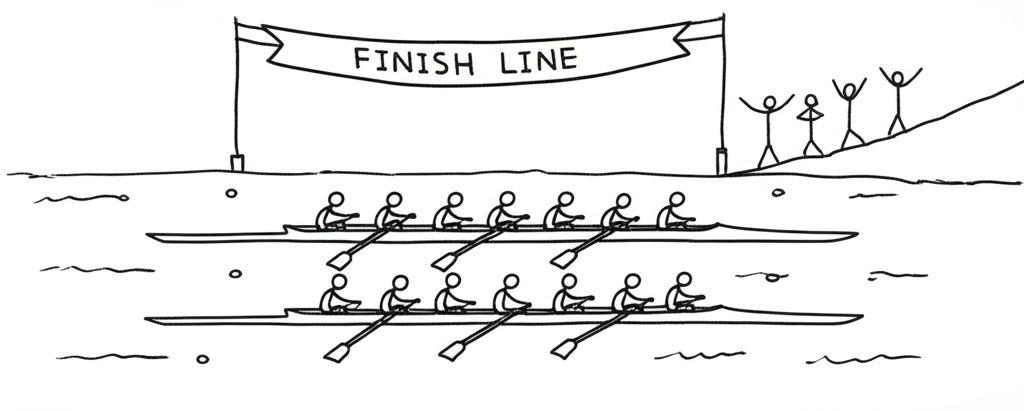
Boats race side-by-side over a straight course, typically 2,000 meters (the Olympic distance) or 1,000 meters. Each race has 3-6 boats in lanes. If there are more entries than lanes, heats and finals determine the winner.
Sprint racing is dramatic and fast. A 2,000m race takes 5-8 minutes depending on the boat class and conditions.
Head Races
Boats race one at a time over a longer course, typically 3-6 km (2-4 miles), with a time-trial format. Boats launch at intervals (usually 10-15 seconds apart) and are ranked by finishing time.
Head races are less intense but longer — 15-25 minutes per race. The most famous head race in the US is the Head of the Charles in Boston, which draws 11,000+ athletes every October.
Most beginner-friendly regattas are sprints, though head races are common in fall and are generally more relaxed.
Before the Regatta
Registration
Your club or coach handles registration. You'll need:
- A USRowing membership — required for sanctioned regattas. Your club may have included this in your dues, or you can register at usrowing.org. Annual membership is ~$75.
- Your event entry — your coach selects the events you'll race (boat class, age category, experience level). You don't need to do this yourself.
Know Your Event
Understand what you're racing before you arrive:
- Boat class: What type of boat? An eight (8+)? A four (4+)? A double (2x)?
- Category: Most regattas have novice/beginner categories separate from experienced rowers. Masters events are divided by age groups (A: 21-26, B: 27-35, C: 36-42, D: 43-49, E: 50-54, F: 55-59, etc.).
- Distance: 2000m, 1000m, or head race distance?
- Race time: Your race time will be posted in a schedule (called the "heat sheet") the day before or morning of the regatta.
What to Pack
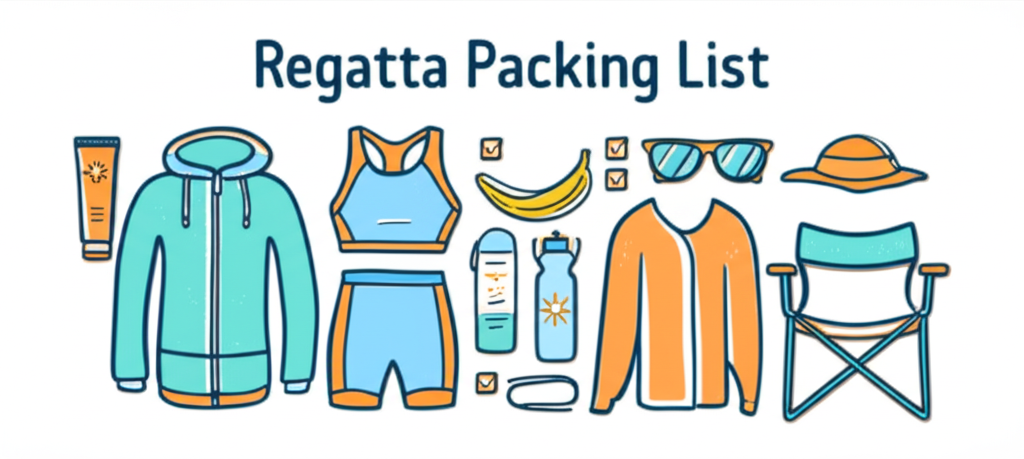
Essential:
- USRowing membership card or number
- Club uniform/racing kit (your club will tell you what to wear)
- Water bottle (you'll be in the sun all day)
- Sunscreen — reapply every 2 hours
- Sunglasses with a strap
- Comfortable shoes for walking around the venue
- Light snacks: bananas, granola bars, PB&J, sports drink
- Rain gear (racing happens in rain)
- Warm layers (mornings at the water are cold, even in summer)
- Change of clothes (you will get wet or sweaty)
Nice to have:
- Folding chair or blanket for tent area
- Portable phone charger
- Binoculars for watching other races
- A book or game for downtime between races
- Cash (some vendors are cash-only)
Don't forget:
- Your specific rowing shoes if your boat doesn't have built-in shoes
- Any prescription medication
- A positive attitude — this is supposed to be fun
Race Day Timeline
Here's what a typical sprint regatta day looks like.
Arrival (2-3 Hours Before Your Race)
Arrive early. Find your club's tent or trailer area. Help unload boats and oars from the trailer and rig the boats (attach the outriggers and oars). Your coach will direct this.
Warm-Up (60-90 Minutes Before)
- Land warm-up: Light jogging, dynamic stretches, and a few minutes on the erg if one is available. Get your heart rate up and loosen your muscles.
- Boat warm-up: Your crew will launch 45-60 minutes before race time and warm up on the water. This typically includes steady-state rowing, some technique drills, practice starts, and a few 10-stroke bursts at race pace. The warm-up also lets you get familiar with the course, wind conditions, and traffic patterns.
Staging (15-20 Minutes Before)
After warming up, row to the staging area (also called the "ready area" or "marshaling area"). An official will organize boats by race number and direct you into position. Follow their instructions.
At the Start Line
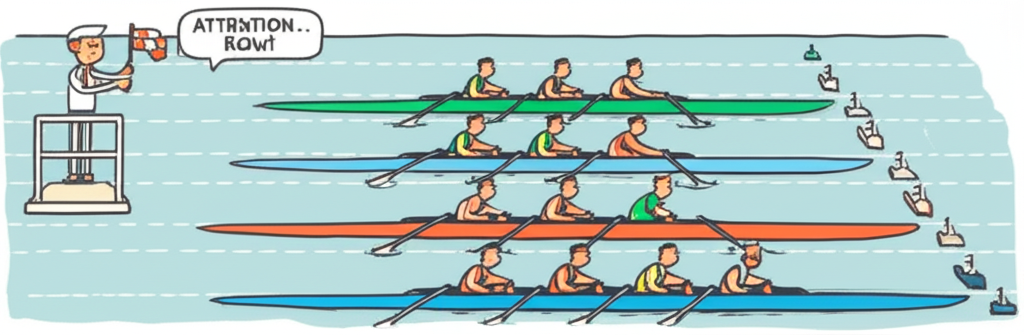
In sprint racing, boats are aligned at the start using stakes (platforms with a person holding your stern) or self-aligned behind a start line. The starting commands are:
- "Attention..." — Get ready. Stop moving. Blades squared and buried.
- "Row!" (or a buzzer/horn) — GO.
Some regattas use the FISA (international) start procedure: the starter calls each boat by lane to confirm readiness, then "Attention... Go."
The Race
For a 2000m sprint, the race takes 5-8 minutes. Your coxswain (or stroke seat, in uncoxed boats) manages the race plan. The typical structure:
| Segment | What Happens |
|---|---|
| Start | High rate (38-44 spm), powerful first 10-20 strokes to build boat speed |
| Settle | Drop to race rate (30-36 spm), establish rhythm |
| Middle 1000m | Maintain rhythm, stay technical, keep contact with other boats |
| Sprint | Final 250-500m, rate up, empty the tank |
Listen to your coxswain. Their job is to manage the race, call moves, and keep you informed of position. Trust the plan.
After Crossing the Finish
- Paddle to cool down and catch your breath.
- Row to the dock area as directed by officials.
- Dock carefully, remove oars, and carry the boat back to your staging area.
- Drink water. Eat something.
Between Races
If you're racing multiple events (common at regattas), you may have 1-4 hours between races. Stay hydrated, eat light meals, stay warm, and do a short warm-up before each subsequent race.
Awards
Awards ceremonies happen at the end of the regatta or after each event. Medals or trophies go to the top finishers (usually top 3). Even if you don't medal, finishing your first race is an achievement worth celebrating.
Racing Etiquette
On the Water
- Stay in your lane during sprint races. Crossing into another crew's water (called "encroachment") can result in disqualification.
- Follow the traffic pattern. Every course has rules about which direction to row, where to warm up, and where to dock. Pay attention during the coaches' meeting and follow your coxswain's navigation.
- Don't stop on the course unless there's a safety issue. If something goes wrong, raise a hand to signal the officials.
At the Venue
- Be on time. Missing your race start is usually a scratch (DNS — did not start). There's no rescheduling.
- Help your club. Carry boats, hold riggers, help other crews launch and dock. Rowing is a communal sport.
- Cheer for everyone. Even competitors from other clubs. The rowing community is small and friendly.
- Clean up. Leave your tent area cleaner than you found it.
Your Race Plan
For your first race, keep it simple. Talk to your coach about the specifics, but a beginner race plan typically looks like this:
- Strong start. First 10-20 strokes at a high rate to build speed. You'll practice race starts before the regatta.
- Settle into rhythm. After the start, find a sustainable rate and focus on technique.
- Stay in the boat. Don't look around at other crews. Focus on your own blade work and timing with your crewmates.
- Finish hard. When your coxswain calls the sprint (usually the last 200-300m), give everything you have left.
Don't worry about winning your first race. Focus on executing the race plan, staying in sync with your crew, and finishing. The result is secondary to the experience.
What If Something Goes Wrong?
Things go wrong at regattas. It's part of the sport. Here are common scenarios:
- A crab. Your oar gets caught in the water and gets stuck. It happens to everyone, from beginners to Olympians. Stay calm, get the oar free, and get back in rhythm.
- Bad conditions. Wind and waves make rowing harder. Shorten up, focus on balance, and don't panic. The officials won't run races in unsafe conditions.
- Equipment issues. An oarlock breaks. A seat comes off the track. If it happens before the start, signal the officials. If mid-race, do your best or stop and signal for assistance.
- Losing badly. Your first race might not be close. That's okay. Everyone starts somewhere. Focus on your own rowing and finish strong regardless of margin.
Types of Regattas to Look For
As a beginner, look for these regatta types:
- Club regattas and invitationals: Lower-key events hosted by a local club. Fewer entries, more relaxed, and often have beginner categories.
- Novice regattas: Specifically for first-year rowers. Everyone is new. This is your best first race.
- Masters regattas: For adult rowers, organized by age categories. Very welcoming to beginners.
Browse our events directory for upcoming regattas across the country.
More Resources
- Browse rowing events — find regattas near you
- On-water race times — what competitive race times look like
- Rowing boat types explained — understand the boats you'll be racing
- How to join a rowing club — get started with a club program
- The complete beginner's guide to rowing technique — polish your technique before race day