
Beginner Rowing Machine Workout: A 4-Week Plan From Zero
The rowing machine is easy to start and easy to get wrong. Most beginners sit down, pull as hard as they can at a high stroke rate, and are done in four minutes with sore hands and a sore lower back. This plan does the opposite: short, easy pieces that teach the stroke, then a steady build to 30 minutes of continuous rowing over four weeks.
You need about 20–35 minutes, three times a week. It works on any rowing machine, though the numbers (split, watts, stroke rate) are easiest to follow on one with a proper monitor.
Before you start: set up the machine
- Feet: strap in so the strap crosses the widest part of your foot, at the base of the toes.
- Damper: if your machine has one, set it to 3–5. That's what Concept2 recommends for starting out. Damper 10 isn't "harder" in a useful way; it makes each stroke heavier, which is a fast way to a sore back.
- Monitor: set it to show split (time per 500 m) and stroke rate (strokes per minute). These two numbers are all you need for now.
The one technique rule that matters
The drive goes legs, then body, then arms. The recovery goes back the other way: arms, then body, then legs. Almost every beginner mistake comes from mixing this order up, usually by bending the knees before the hands have passed them, or by pulling with the arms before the legs have finished pushing.
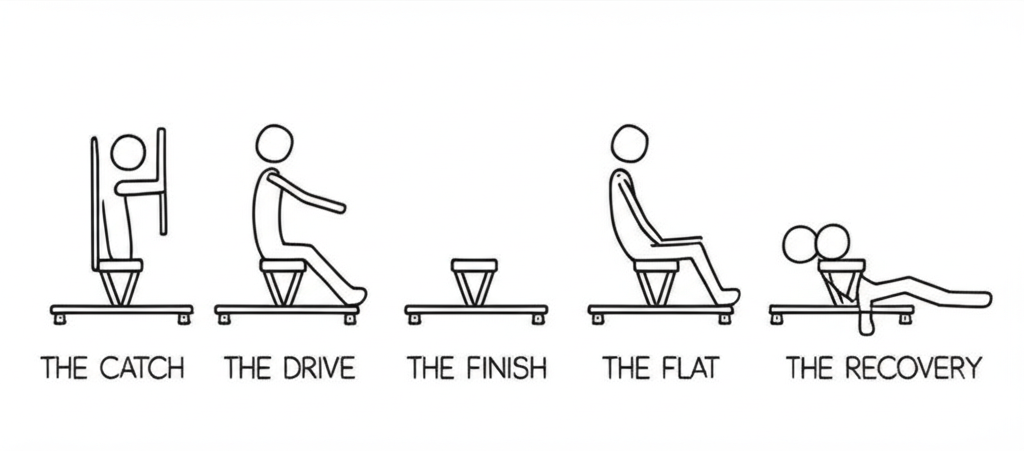
The recovery should take about twice as long as the drive. If it feels like you're rushing back to the front, you are. For a full breakdown, see our rowing technique guide for beginners.
How hard should it feel?
All of this plan is easy unless it says otherwise. Easy means:
- You could talk in short sentences.
- Stroke rate sits around 20–24 strokes per minute.
- You finish feeling like you could do it again.
Don't chase a split yet. Write down the average split for each session; it will drop on its own as your technique improves.
The 4-week plan
Do the three sessions on non-consecutive days, for example Monday, Wednesday and Friday. Start each one with 3 minutes of very easy rowing (arms only, then arms and body, then full strokes) and finish with 2 minutes easy.
| Week | Session A | Session B | Session C |
|---|---|---|---|
| 1 | 5 × 2 min easy, 1 min rest | 4 × 3 min easy, 1 min rest | 3 × 4 min easy, 1 min rest |
| 2 | 4 × 4 min easy, 1 min rest | 3 × 6 min easy, 1 min rest | 2 × 8 min easy, 2 min rest |
| 3 | 3 × 8 min easy, 1 min rest | 6 × 1 min firm / 2 min easy (no stopping) | 2 × 10 min easy, 2 min rest |
| 4 | 20 min continuous easy | 8 × 1 min firm / 1 min easy (no stopping) | 30 min continuous easy |
"Firm" means a noticeably faster split than your easy pace, at 24–26 strokes per minute, but not a sprint. You should be able to hold the same split for every firm minute; if the last two are much slower than the first two, you started too hard.
If a week feels too hard
Repeat it. There's no prize for finishing in four weeks. The aim is to get through every session with good technique.
If it feels too easy
Keep the time the same and stay easy. Beginners who speed up the plan usually do it by rowing harder, which defeats the purpose. Once week four is comfortable, move on (see below).
Three mistakes to watch for
- Shooting the slide. The seat moves back but the handle doesn't, because the legs push before the back and arms are connected. Keep your arms straight and your core braced as the legs start the drive.
- Reaching too far at the catch. Your shins should be roughly vertical at the front. Going further pushes your knees into your chest and puts your back in a weak position.
- Gripping too hard. Hold the handle with your fingers, thumbs underneath, wrists flat. A death grip tires your forearms long before your legs.
After week four
You now have the base to train properly. Three good next steps:
- Get your numbers. Do a steady 2,000 m at a pace you can hold the whole way. Plug the time into our training zones calculator to get split targets for easy and hard days.
- Add one interval day. Swap one session a week for a HIIT rowing workout.
- Learn what your split means. The erg pace calculator converts any split to watts and calories, and our erg benchmarks show what times are typical for your age.
If you're still choosing a machine, our rowing machine buyer's guide compares the main options.
Frequently asked questions
›How long should a beginner row on a rowing machine?
Start with 10 to 15 minutes of rowing broken into short pieces with rest, three times a week. The plan below builds to 30 minutes of continuous rowing by week four.
›What damper setting should a beginner use?
Concept2 recommends starting at a damper setting of 3 to 5. A higher damper does not mean a better workout; it mostly makes each stroke heavier and tires your back and arms sooner.
›What stroke rate should a beginner row at?
Around 20 to 24 strokes per minute for easy rowing. If your rate is above 28 while rowing easily, you are probably rushing the recovery.
›Is it OK to row every day as a beginner?
Three days a week with a rest day between sessions is a better start. Add a fourth day once the week-four sessions feel easy.