
Strength Training for Rowers: The Essential Gym Guide
Rowing is a strength-endurance sport. You need the aerobic engine to sustain effort for 6-8 minutes (or longer) and the muscular strength to apply force every single stroke. Strength training bridges the gap — it builds the raw power that your technique and aerobic fitness convert into boat speed.
But not all gym work is created equal for rowers. Here's what to prioritize, what to skip, and how to program it alongside your rowing training.
Why Rowers Need the Gym
The rowing stroke demands force production through three movement patterns:
- The leg drive — a pushing movement (like a squat or leg press)
- The body swing — a hip hinge (like a deadlift or Romanian deadlift)
- The arm draw — a horizontal pull (like a barbell row)
Strength training develops the raw force capacity of these patterns. A stronger squat means a harder leg drive. A stronger deadlift means a more powerful body swing. More pulling strength means a cleaner finish.
Research consistently shows that adding strength training to a rowing program improves 2K erg times even without additional rowing volume. The mechanism is straightforward: more force per stroke means either more speed at the same effort, or less effort at the same speed.
The Core Exercises
These are the highest-priority movements for rowers. If you only have 30 minutes in the gym, do these.
Front Squat
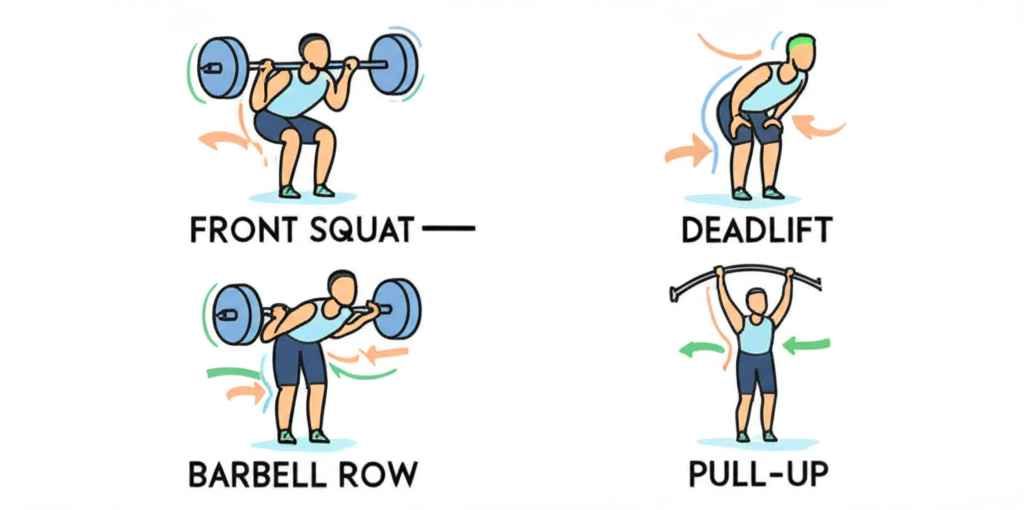
Why: The front squat may be the single best gym exercise for rowing. The front-loaded position forces an upright torso, mimicking the posture demands of the rowing drive. It builds quad strength (the primary leg drive muscles), challenges core stability, and requires upper back engagement to hold the bar in the rack position.
How: Bar in the front rack position (crossed arms or clean grip), feet shoulder-width apart, squat to parallel or below. Keep the chest up and elbows high. If front rack mobility is a problem, goblet squats with a heavy dumbbell or kettlebell are an excellent substitute.
Sets/Reps: 3-5 sets of 3-6 reps. This is a strength exercise, not a conditioning one. Use heavy weight with full rest between sets (2-3 minutes).
Back Squat
Why: The back squat allows heavier loading than the front squat and builds overall lower body strength. It's less rowing-specific in posture but develops raw leg power that transfers directly to the drive.
How: Bar on the upper back (high bar) or across the rear delts (low bar). Squat to at least parallel. A full-depth squat builds strength through a larger range of motion, which benefits the compressed position at the catch.
Sets/Reps: 3-5 sets of 3-8 reps.
Deadlift
Why: The deadlift trains the posterior chain — glutes, hamstrings, and erector spinae — which generates power during the body swing phase of the stroke. A strong deadlift also protects the lower back, the most commonly injured area in rowers.
Going from a below-average to an above-average deadlift is one of the fastest paths to a better erg time. The hip hinge pattern transfers almost perfectly to the rowing stroke.
How: Conventional or sumo stance. Drive through the floor, hinge at the hips, lock out at the top with glutes squeezed and shoulders back. Keep the bar close to the body throughout.
Sets/Reps: 3-5 sets of 3-5 reps. Deadlifts fatigue the central nervous system significantly — keep volume moderate and quality high.
Romanian Deadlift (RDL)
Why: The RDL isolates the hip hinge pattern more than the conventional deadlift, with greater emphasis on hamstring lengthening under load. It builds the eccentric strength needed to control the body position during the recovery phase and load the catch effectively.
How: Start from standing with the bar at hip height. Push hips back, lower the bar along the thighs while maintaining a flat back. Go to just below the knees (or wherever you feel a strong hamstring stretch). Stand back up by driving hips forward.
Sets/Reps: 3-4 sets of 6-10 reps. Moderate weight, focus on the stretch and control.
Barbell Row (or Dumbbell Row)
Why: Horizontal pulling strength directly supports the arm draw at the finish of the stroke. Strong lats and rhomboids also help maintain posture throughout the drive and connect the arm draw to the body swing.
How: Bent over at the hips with a flat back, pull the barbell to the lower chest/upper abdomen. Squeeze the shoulder blades together at the top. For single-arm dumbbell rows, one hand on a bench, pull the dumbbell to the hip.
Sets/Reps: 3-4 sets of 6-10 reps.
Pull-Ups / Lat Pulldowns
Why: Vertical pulling builds lat width and strength. Strong lats create a better "hang" at the catch — the ability to suspend your bodyweight from the handle and use your body weight to load the stroke.
How: Pull-ups (overhand, shoulder-width grip) or lat pulldowns if you can't do 8+ strict pull-ups yet. Full extension at the bottom, chest to bar at the top.
Sets/Reps: 3-4 sets of 6-12 reps (or max reps if building to higher numbers).
Core Work for Rowing
Rowing demands constant core stability — your abdominals and obliques transmit force from the legs through the trunk to the arms. A weak core "leaks" power. Here are the best options.
Plank Variations
Front plank, side plank, and plank with reaches. Hold for 30-60 seconds per set. These build the isometric core stability that rowing demands — your core doesn't crunch during the stroke, it braces.
Hanging Leg Raises
Hang from a pull-up bar and raise your legs (straight or knees bent) to hip height or above. Builds lower abdominal strength and hip flexor endurance, both important for the catch position.
Pallof Press
Hold a cable or band at chest height and press it straight out in front of you. This anti-rotation exercise builds the oblique stability needed to resist twisting during the stroke — especially important in sweep rowing where forces are asymmetric.
Back Extensions
On a GHD (glute-ham developer) or a 45-degree back extension bench. Strengthens the erector spinae and helps prevent the lower back injuries that plague rowers. 3 sets of 12-15 reps, bodyweight or holding a light plate.
What to Skip
Not every popular gym exercise helps rowers, and some are counterproductive.
- Bicep curls and tricep extensions. Isolation arm work doesn't transfer to rowing. Your arms get plenty of work from rows, pull-ups, and the rowing stroke itself.
- Leg extensions and leg curls. These machine exercises isolate individual muscles in a non-functional pattern. Squats and deadlifts train the same muscles in patterns that actually transfer.
- Heavy bench press. Pushing strength has minimal transfer to rowing. If you want to include pressing for shoulder health, light overhead press or push-ups are sufficient.
- High-rep, light-weight circuit training. The erg already provides endurance training. The gym is for building strength you can't build on the erg — that means heavy loads and full recovery between sets.
- Excessive abdominal crunches. Rowers are already in spinal flexion hundreds of times per session. Adding more flexion in the gym increases back injury risk. Stick to stability-based core exercises (planks, Pallof press, anti-extension).
Programming: How to Fit Gym Work Into Rowing Training
General Principles
- 2-3 strength sessions per week is optimal for most rowers. More than that cuts into recovery for rowing.
- Place strength sessions after easy rowing days, not before hard interval sessions. You don't want fatigued legs for a threshold or race-pace workout.
- Full-body sessions are more practical than body-part splits. Rowers need balanced development, not bodybuilding specialization.
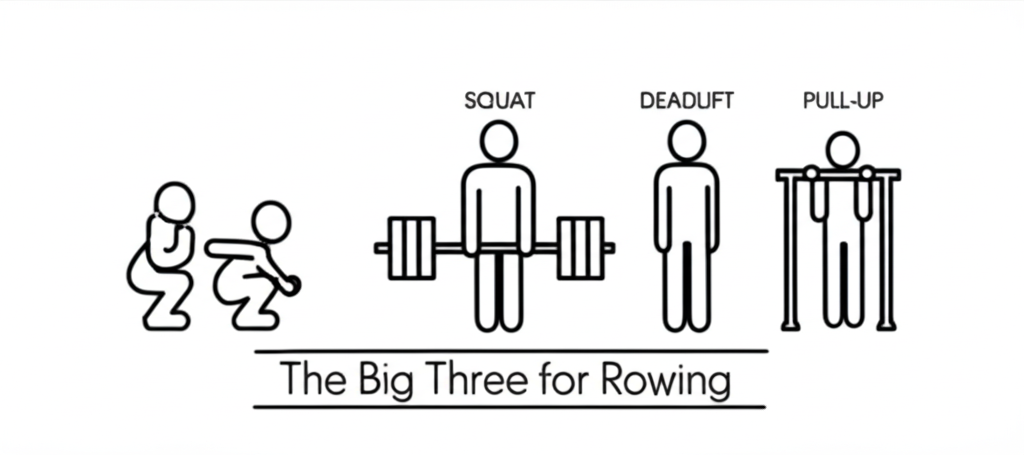
- Prioritize compound movements. Squat, deadlift, row, pull-up. Accessory work fills time if you have it, but the big lifts drive the adaptations.
Off-Season (Base Building Phase)
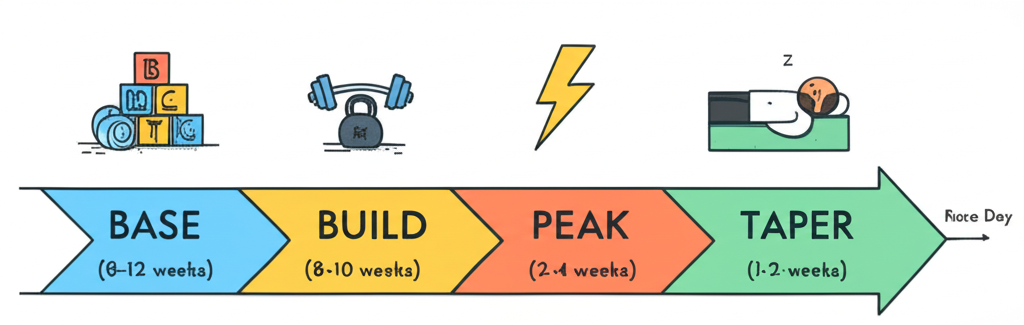
The off-season is when you build raw strength. Rowing volume is moderate and intensity is low (mostly steady state), leaving room for the gym.
| Day | Focus | Example |
|---|---|---|
| Monday | Strength A | Front squat 4x5, Barbell row 4x8, Pull-ups 3x8, Plank 3x45s |
| Tuesday | Steady state | 60 min erg at rate 20 |
| Wednesday | Strength B | Deadlift 4x5, RDL 3x8, Dumbbell row 3x10, Back extensions 3x12 |
| Thursday | Steady state | 3x20 min erg at rate 18 |
| Friday | Strength A | Back squat 4x6, Pull-ups 4x6, Pallof press 3x10, Hanging leg raises 3x10 |
| Saturday | Steady state | 45-60 min erg |
| Sunday | Rest |
In-Season (Competitive Phase)
During the racing season, rowing takes priority. Strength training shifts to maintenance mode — keep the strength you've built without accumulating fatigue.
- Reduce to 2 sessions per week
- Reduce volume (fewer sets) but maintain intensity (same weight)
- Keep compound movements, drop most accessories
- Never lift heavy the day before a race or hard erg test
Erg-Only Athletes
If you row exclusively on an erg (no on-water training), you have more recovery capacity for gym work. You can handle 3 solid strength sessions per week year-round, since erg sessions are less technically draining than on-water rowing.
Progressive Overload
The most common mistake in strength training for rowers is treating the gym as a casual supplement. If you're not progressively adding weight to the bar over weeks and months, you're not getting stronger.
Track your lifts. Add 2.5-5 lbs per session when you can complete all sets and reps with good form. When progress stalls (it will), deload for a week at 60-70% of your working weights, then build back up.
Strength benchmarks for rowers (rough targets for a 180-lb male rower):
| Exercise | Beginner | Intermediate | Strong |
|---|---|---|---|
| Back Squat | 135 lbs | 225 lbs | 315 lbs |
| Front Squat | 115 lbs | 185 lbs | 265 lbs |
| Deadlift | 185 lbs | 315 lbs | 405 lbs |
| Barbell Row | 95 lbs | 155 lbs | 225 lbs |
| Pull-Ups | 5 reps | 12 reps | 20 reps |
These are guidelines, not requirements. Any improvement in strength will help your rowing. The jump from "beginner" to "intermediate" typically produces the most noticeable erg improvement.
Injury Prevention
Rowing's repetitive motion creates predictable injury patterns. Smart gym programming prevents them.
- Lower back: The most common rowing injury. Deadlifts, back extensions, and core stability work protect the lumbar spine. Avoid excessive spinal flexion under load.
- Ribs: Stress fractures from overtraining. Strength training doesn't directly prevent rib stress fractures, but a stronger frame distributes force better. The main prevention is managing training load.
- Shoulders: Impingement from repetitive pulling. Include face pulls (3x15-20 with a cable or band) and external rotation work as a warm-up. These maintain rotator cuff health and counter the internal rotation bias of rowing.
- Knees: Patellar tendon issues from the deep knee flexion at the catch. Squats through a full range of motion actually protect the knees by strengthening the tendons and surrounding musculature. Don't skip depth.
More Resources
- How to improve your erg time — the complete training plan that complements gym work
- Erg benchmarks by age and level — track how strength gains translate to faster times
- Training tools and apps — apps for tracking rowing and gym training
- Rowing Stronger — the best resource for rowing-specific strength training