
How to Improve Your 2K Erg Time and Rowing Split
You've done the 2K test. You know your number. Now you want it lower. Whether you're trying to break 7:00 for the first time or shave two seconds off an already competitive split, the path to a faster erg time is the same: train smarter, fix your technique, and race with a plan.
Here's how to do all three.
Build Your Aerobic Base First
This is the most important — and most ignored — piece of advice in rowing. Roughly 80% of your training should be low-intensity steady state. The 2K is approximately 75-80% aerobic, which means your cardiovascular engine matters far more than your ability to suffer through a sprint.
Steady-state rowing means 60-90 minutes at 60-70% of your max heart rate, typically at 18-22 strokes per minute. It should feel conversational. If you can't talk, you're going too hard.
This is the polarized training model used by elite endurance athletes across rowing, cycling, running, and cross-country skiing: ~80% of your volume at genuinely easy effort, ~20% at genuinely hard effort, and almost nothing in the moderate "gray zone" between them.
Example steady-state workouts:
- 3 x 20 min at rate 18-20, 2 min rest
- 60 min continuous at rate 20
- 4 x 15 min at rate 18, 1 min rest
It's tempting to skip these and go hard every session. Don't. The aerobic base built through steady state is the platform for everything else.
Fix Your Technique
Technique improvements are free speed. You don't need to be fitter — you just need to stop wasting energy. Here are the biggest fixes.
Get the Sequence Right
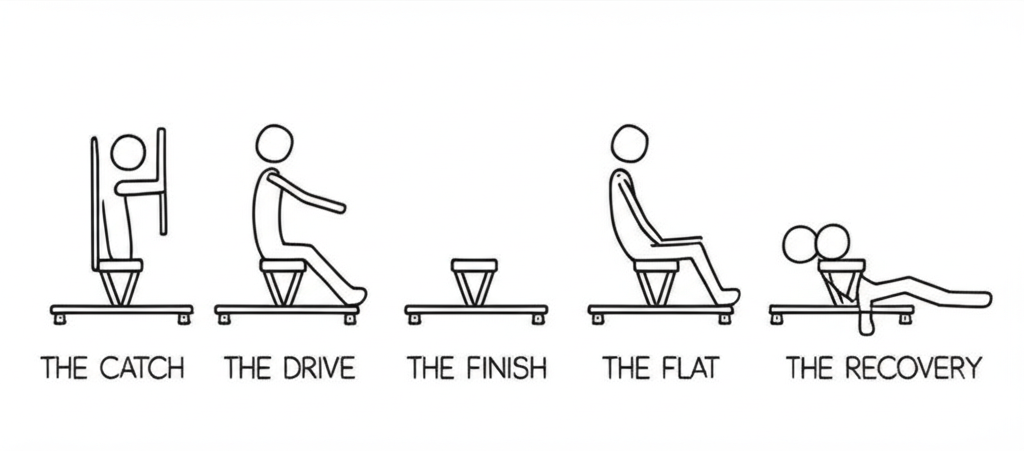
The drive is legs, body, arms. The recovery is the reverse: arms, body, legs. Power distribution across the stroke is roughly 60% legs, 30% body swing, and 10% arms.
The most common error is pulling with the arms before the legs finish. This wastes your most powerful muscle group. Push with your legs first, swing the body back, then pull the handle to your lower ribs.
Stop Rushing the Recovery
The recovery is your rest. It should be slower than the drive — and it should decelerate as you approach the catch. Most rowers do the opposite, rushing into the catch, which destroys timing and bleeds energy. Think of the recovery as loading a spring: controlled, deliberate, and patient.
Don't Overcompress at the Catch
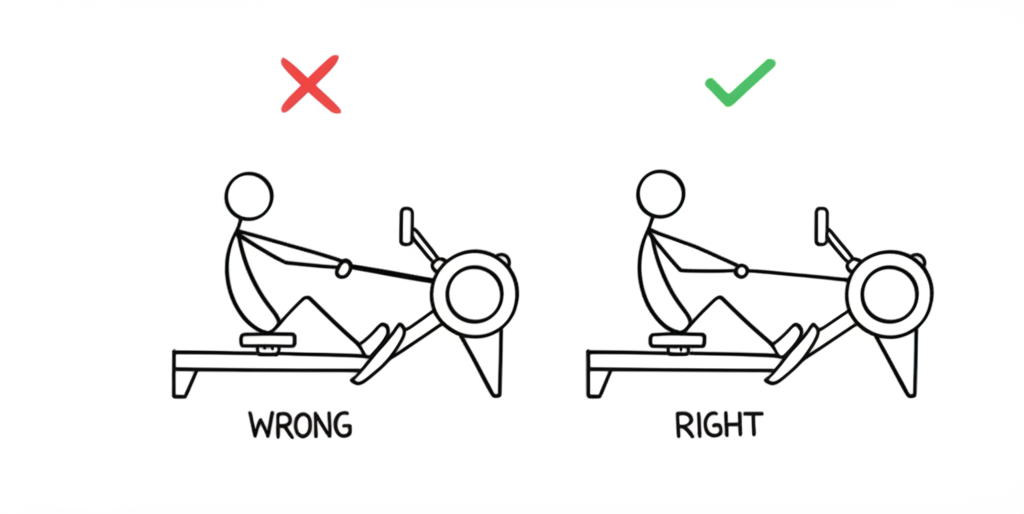
Your shins should be vertical (or close to it) at the catch. Going past vertical puts your legs in a weak mechanical position and reduces drive effectiveness. If you're cramming your knees into your chest, you're going too far.
Fix Your Grip
Wrap your fingers over the handle with thumbs underneath. Wrists flat and relaxed. A death grip on the handle will fatigue your forearms long before the piece is over. This is especially important in longer pieces where grip fatigue compounds over hundreds of strokes.
Use the Right Damper Setting
The damper lever is not a difficulty dial. Concept2 recommends starting at 3-5, which corresponds to a drag factor of roughly 110-140. This is the range most competitive rowers use — including Olympians. A higher setting exhausts your muscles before your cardiovascular system gets a full workout. Think of it like bike gearing: you want to spin efficiently, not grind in top gear.
Structure Your Training
A well-structured training block moves through four phases.
Phase 1: Base Building (8-12 Weeks)
High volume, low intensity. Mostly steady-state work with 2-4 strength training sessions per week. Build your aerobic engine and general strength.
Phase 2: Build (8-10 Weeks)
Introduce threshold work — pieces at 80-90% max heart rate where your body is producing lactate at approximately the same rate it clears it. Strength work shifts from hypertrophy to maximal strength.
Example threshold workouts:
- 3 x 10 min at AT pace, 3 min rest
- 4 x 8 min at AT pace, 2 min rest
Phase 3: Peak (2-4 Weeks)
Race-specific intensity. This is where you do the hardest workouts of the entire cycle — race-pace intervals, practice 2K pieces, and high-intensity short intervals. Volume decreases as intensity increases.
Example peak workouts:
- 8 x 500m at 2K pace, 3 min rest
- 5 x 1500m at 2K +3-5 splits, 3 min rest
- 3 x 2000m at race pace, 5 min rest
Phase 4: Taper (1-2 Weeks)
Volume drops significantly, but intensity stays. The goal is letting your body fully absorb the training you've already done. Sleep, nutrition, and recovery are paramount. Don't do anything new — just stay sharp.
Concept2's free 12-week 2K training plan follows a similar structure and is a great starting point if you don't have a coach.
Race With a Plan
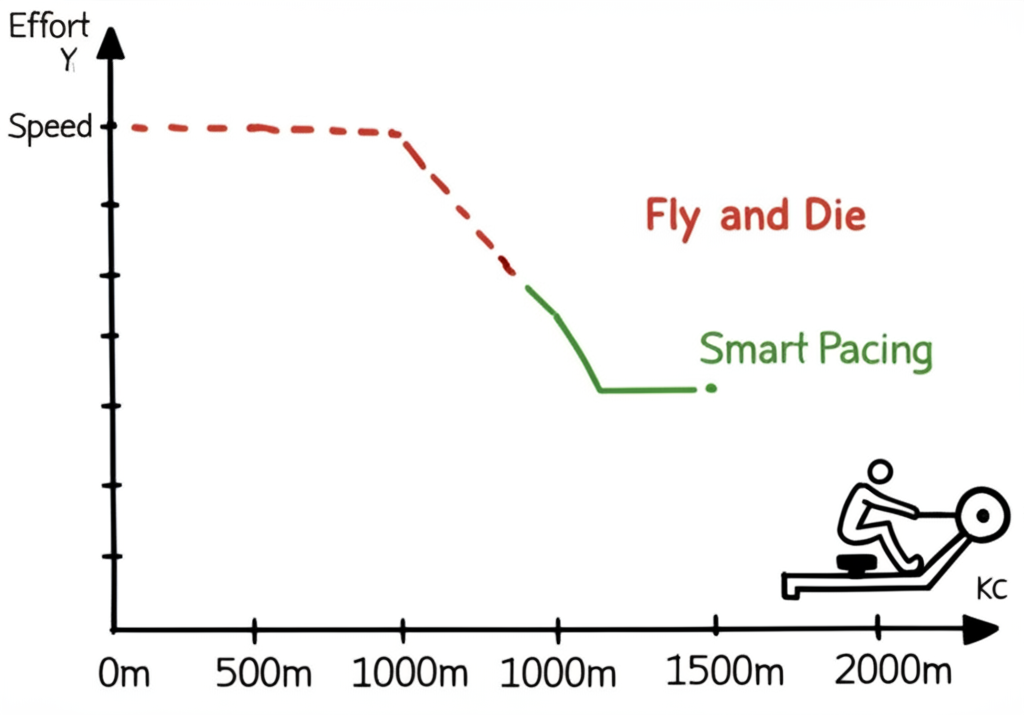
The single most common mistake in a 2K test is going out too fast. An unrealistically fast first 500m creates oxygen debt and metabolic acidosis that ruins the remaining 1500m. This is the dreaded "fly and die."
The Best Pacing Strategy
Research and competitive results point to a slightly parabolic pacing profile — a strong start, settling into pace, and a hard finish — as the most effective approach for experienced rowers. For those newer to racing, even splits are a reliable and safer strategy.
Here's a practical plan:
| Segment | Strategy |
|---|---|
| First 500m | Target split +0-1 seconds. Strong start (first 5-10 strokes), then settle quickly. |
| Second 500m | Target split exactly. Establish rhythm, focus on technique. |
| Third 500m | Target split or 0.5 sec faster. The hardest segment mentally — stay disciplined. |
| Final 500m | Empty the tank. Sprint the last 250m. |
If your target is a 1:45 split (7:00 2K), your 500m segments might look like: 1:45.5, 1:45.0, 1:44.5, 1:43.0.
How to find your target split: Use predictor workouts. If you can hold a split for 8 x 500m with 3 minutes rest, you can hold that split for a 2K. If the last few intervals are falling apart, your target is too aggressive.
Train Your Mind
The 2K is 7-8 minutes of voluntary suffering. Your brain will tell you to stop long before your body needs to. Here's how to manage that.
Chunk the Race
Don't think about 2000 meters. Break it into four 500m segments, each with its own job. Or count strokes in sets of 10, giving each set a focus: "ten strokes on leg drive, ten on body swing, ten on relaxing the grip." Keeping the mind busy with micro-goals crowds out the pain.
Reframe the Discomfort
When your legs are screaming at 1200m, notice it without fighting it. "My legs are burning" is an observation. "I can't take this anymore" is a catastrophe. The difference in self-talk matters measurably.
Visualize Before You Sit Down
Before the test, mentally rehearse the entire piece — the aggressive start, the settle into rhythm, the grind through the third 500, the sprint to the finish. Visualize hitting your target splits and the feeling of seeing the final meters count down.
Build Tolerance Through Exposure
The tenth time you hold 1:42 for 500m, it doesn't feel like the first time. Hard interval training builds mental familiarity with discomfort as much as it builds physical fitness. By race day, you should have already experienced the worst of it in training.
Support Your Training Off the Erg
Strength Training
The rowing stroke mimics three movement patterns: the squat, the hinge, and the pull. The best strength exercises for rowers:
- Front squats — May be the single best exercise for rowing performance. Emphasizes quads, core, and upper back, all crucial for a powerful drive.
- Deadlifts — Developing from a poor to above-average deadlift is one of the fastest ways to improve an erg time.
- Rows and pulls — Horizontal and vertical pulling builds the back strength needed for the arm draw.
Schedule heavy strength days alongside steady-state sessions, not before hard interval days.
Nutrition
- Carbohydrates are your primary fuel. Periodize intake based on training load — more on hard days, less on rest days.
- Protein: 20-25g every 3-5 hours for muscle repair. A recovery meal within 30-60 minutes of hard sessions.
- Race day: Eat a normal meal 3-4 hours before the test. Nothing within 1 hour of the test. Caffeine (3-6 mg/kg, 30-60 min before) is one of the most well-supported performance aids for rowing.
Sleep
This is the most underrated performance enhancer. Aim for 8-9 hours per night, especially in the week before a test. Sleep deprivation impairs endurance, reaction time, and mood. In the days before a big test, prioritize sleep above everything else. If your test is in the morning, being awake for approximately 3 hours beforehand is ideal.
Track Your Progress
You don't need to do a full 2K test every week. Use these predictor workouts to gauge fitness without the full toll of a max effort:
| Workout | What It Tells You |
|---|---|
| 8 x 500m at target 2K split, 3 min rest | If you can hold all 8, you're ready |
| 2 x 2000m at 2K pace, 5 min rest | If the second piece is faster, you're pacing conservatively enough |
| 3 x 2000m at 2K +5 splits, 4 min rest | Builds race-pace familiarity without max effort |
| 6K continuous at 2K +10-15 splits | Establishes your aerobic baseline and steady-state training pace |
Test your 2K every 6-8 weeks at most. More frequent testing just accumulates fatigue without telling you much new.
The 10 Fastest Ways to Drop Time
If you're looking for a summary, here it is in priority order:
- Do more steady state. Most rowers don't do enough easy volume.
- Fix your stroke sequence. Legs-body-arms on the drive, arms-body-legs on the recovery.
- Stop going out too hard. Learn to pace.
- Lower your damper setting. Try 3-5 and see what happens.
- Slow down your recovery. Let it decelerate into the catch.
- Add threshold work. Once your base is solid, AT intervals drive big improvements.
- Squat and deadlift. Strength directly transfers to erg speed.
- Sleep more. 8-9 hours, non-negotiable during hard training.
- Practice the 2K. Use predictor workouts so race day isn't a surprise.
- Be patient. Erg fitness builds over months and years, not days.
More Resources
- Erg benchmarks by age and experience level — find out where you stack up
- Erg scores for college recruiting — what coaches are looking for
- Concept2 Training Plans — free structured programs for every distance
- Concept2 Logbook — track your pieces and compare globally
- Rowing Stronger — deep dives on strength training for rowers