
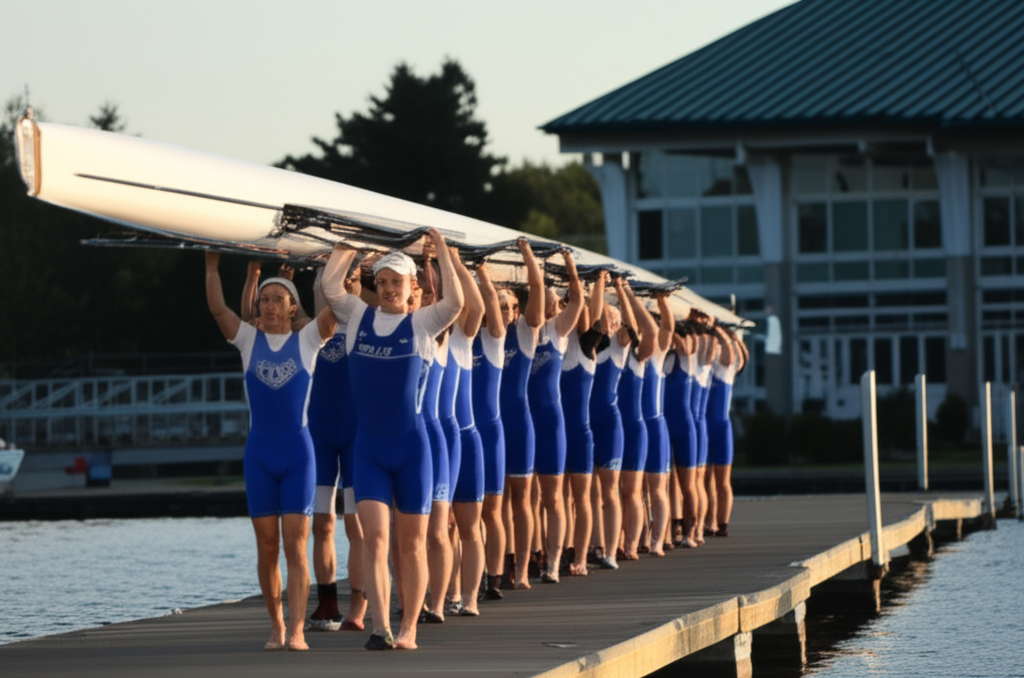
College Rowing Recruiting Erg Times: 2K Scores by Division
If you're a high school rower (or a parent of one), you've probably heard the question a hundred times: "What's your 2K?"
The 2,000m erg test is the universal measuring stick for college rowing recruiting. It's not the only thing coaches care about, but it's the first filter. Here's what you need to know.
Men's 2K Recruiting Benchmarks
Division I — Top Programs (Ivy League, Big Ten, Pac-12)
| Category | Target 2K | Notes |
|---|---|---|
| Heavyweight — elite recruit | Sub-6:15 | Will get calls from the top 10 programs |
| Heavyweight — strong recruit | 6:15–6:25 | Competitive at most D1 programs |
| Heavyweight — on the radar | 6:25–6:35 | Recruited at mid-tier D1 and top D3 |
| Lightweight | 6:30–6:40 | Top lightweight programs |
The bar keeps rising. A decade ago, 6:30 got attention from top programs. Today, elite recruits are regularly sub-6:15, and the middle 50% at top-20 programs sits around 6:30.
Division III
| Category | Target 2K | Notes |
|---|---|---|
| Top of the squad | Low 6:20s | Would be competitive anywhere |
| Middle 50% | ~6:35 | Solid D3 recruit |
| Getting a look | 6:40–6:50 | Worth reaching out to coaches |
Club Programs
Many universities have competitive club rowing programs that offer great racing without the D1 time commitment. Erg times in the 6:40–7:00 range can make you competitive at a strong club program.
Women's 2K Recruiting Benchmarks
Division I — Top Programs
| Category | Target 2K | Notes |
|---|---|---|
| Elite recruit | Sub-7:15 | Top programs will actively pursue you |
| Strong recruit | 7:15–7:30 | Competitive at most D1 programs |
| On the radar | 7:30–7:45 | Mid-tier D1 and scholarship consideration |
Women's rowing is an NCAA sport with scholarships available at D1 and D2, which makes it a significant opportunity. Coaches at some D1 programs have recruited women in the 7:40–7:50 range who showed strong athleticism and potential.
Division III
| Category | Target 2K | Notes |
|---|---|---|
| Top of the squad | Sub-7:30 | Would be top performer |
| Middle 50% | ~7:40 | Solid D3 recruit |
| Getting a look | 7:45–7:55 | Worth reaching out |
Division II
D2 programs vary widely, but benchmarks generally fall between D1 and D3. A sub-7:30 will get strong interest, and times in the 7:30–7:50 range are worth pursuing.
Beyond the Erg Score
Here's what coaches have told us: the erg opens the door, but it's not the whole picture. Coaches also evaluate:
- Height and wingspan. Longer levers generally mean more potential. Many coaches prioritize tall athletes with strong erg scores, even if they're relatively new to rowing.
- Athleticism. A strong multi-sport athlete with a 6:35 may be more attractive than a pure rower with a 6:25 who's already maxed out.
- Trajectory. A junior who went from 7:00 to 6:30 in one year shows coachability and upside.
- On-water skill. A fast erg doesn't guarantee boat speed. Video of you rowing well matters.
- Academics. Especially at D3 and Ivy League programs, grades and test scores are a major factor.
- Character and coachability. Coaches recruit people they want to spend four years with.
Walk-Ons and Novices
Rowing is one of the few college sports where you can walk on with zero experience and earn a varsity seat. If you're tall, athletic, and willing to work, many programs will take a chance on you regardless of erg score. Some of the best college rowers in history were recruited as novices from other sports.
How to Get Recruited
- Get your 2K as fast as possible. Test every 6-8 weeks during junior year.
- Email coaches directly. Send your erg scores, height/weight, GPA, and a video of you rowing. Keep it brief.
- Use recruiting services. NCSA and Sparks have good resources.
- Attend ID camps. Many programs host camps where coaches can evaluate you in person.
- Race at visible regattas. Youth Nationals, Stotesbury, SRAA, and Henley all put you in front of college coaches.
- Start early. D1 recruiting timelines have moved earlier. Begin reaching out to coaches in your sophomore or junior year.
The Bottom Line
| Level | Men's 2K | Women's 2K |
|---|---|---|
| D1 elite | Sub-6:15 | Sub-7:15 |
| D1 competitive | 6:15–6:35 | 7:15–7:45 |
| D3 competitive | 6:25–6:50 | 7:30–7:55 |
| Club competitive | 6:40–7:00 | 7:45–8:15 |
These are guidelines, not hard cutoffs. If you're close, reach out to coaches anyway. The worst they can say is no.
More Resources
- General erg benchmarks by age and experience — see where you stack up outside of recruiting
- NCSA Men's Rowing Recruiting
- NCSA Women's Rowing Recruiting
- Sparks Recruiting Erg Scores